
Blog
Automotorteile erklärt: Ein Leitfaden für Einsteiger

Lift the bonnet of any car and you’re looking at dozens of Automotorteile working together in perfect coordination. To the untrained eye it’s a baffling tangle of metal, hoses and wires — but every component has a clear job, and once you know what each one does, the whole engine suddenly makes sense. This beginner-friendly guide explains the main parts of a car engine in plain language: what each does, where it sits, and why it matters.
Bei Stepgrades-Motor we supply imported, inspected engines to drivers and garages across the UK and mainland Europe, and we know that understanding the parts makes you a more confident owner — better at spotting problems, talking to mechanics, and judging a replacement engine. By the end of this guide you’ll be able to name the key car engine parts and explain what they do, whether you drive a petrol city car in Spain or a diesel estate in Germany.
Understanding car engine parts: the big picture
Before we list individual components, it helps to see how they’re organised. A car engine takes fuel and air, burns it in a controlled way, and turns the energy released into the rotation that drives your wheels — a process explained in our guide to how a car engine works. Every engine part exists to make that happen, so the easiest way to learn them is by the job they do.
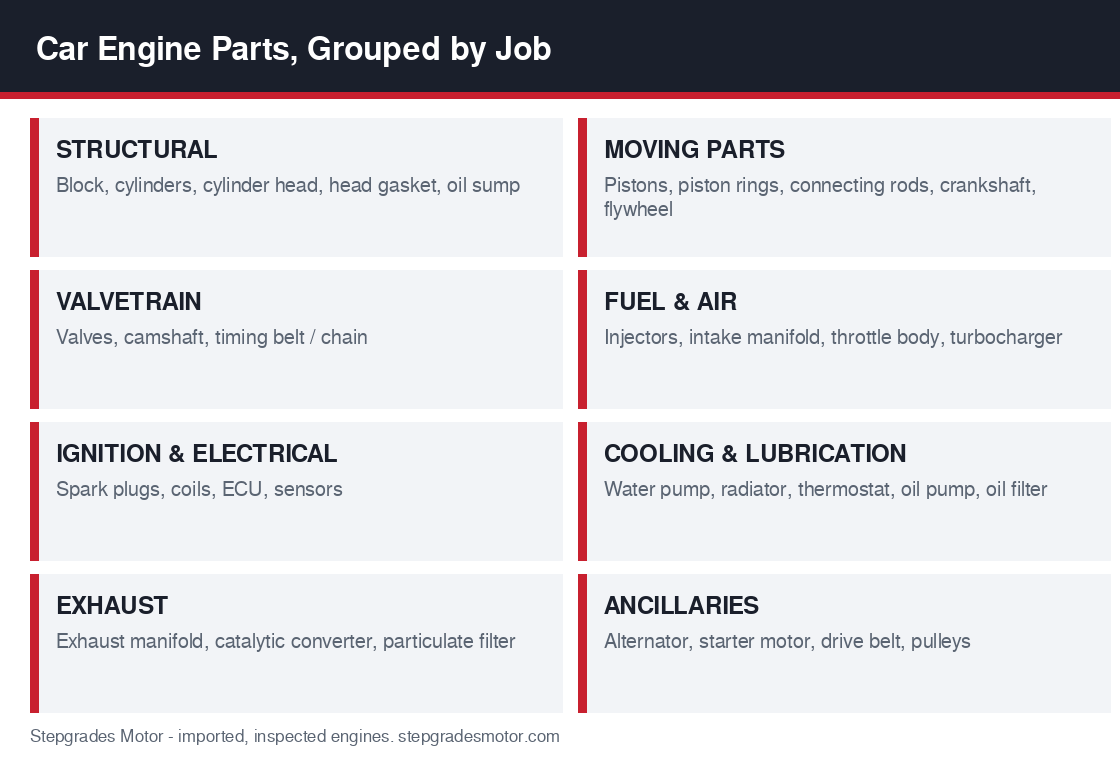
We can group the main car engine parts into seven families: the structural parts that form the engine’s body, the moving parts that turn combustion into rotation, the valvetrain that controls breathing, the fuel and air parts, the ignition and electrical parts, the cooling and lubrication parts, and the exhaust parts. Learn them group by group and the whole engine falls into place.
How many parts does a car engine have?
A modern car engine contains hundreds of individual parts when you count every bolt, seal and sensor — some estimates put a complete engine at well over a thousand components. That sounds overwhelming, but the good news is that you only need to understand a few dozen main ones to grasp how the engine works and to hold a sensible conversation with a mechanic or engine seller.
The majority of those hundreds of parts are small fasteners, seals and electrical connectors that support the two or three dozen major components we cover in this guide. Focus on the main car engine parts and their jobs, and the rest simply fall into place as the supporting cast. Throughout the guide we’ll keep the emphasis on what each key part does and why it matters, rather than drowning you in the full count — because understanding the important parts is what actually makes you a more confident owner and buyer.
Structural parts: the engine’s body
These are the large, mostly stationary parts that everything else bolts to or moves within.
Engine block
The engine block is the foundation of the whole engine — a large casting, usually of aluminium or cast iron, that houses the cylinders and supports almost every other part. It’s the single biggest and most important of the car engine parts, and its condition largely determines an engine’s health.
Cylinders
The cylinders are the round bores within the block where combustion happens and the pistons travel up and down. Most cars have three, four or six cylinders. Their smoothness and seal are critical to compression and power.
Cylinder head
Bolted to the top of the block, the cylinder head seals the cylinders and houses the valves, and often the camshaft and spark plugs or injectors. It’s a precision component, and a warped or cracked head is a serious fault.
Head gasket
The head gasket is a thin but vital seal between the block and the cylinder head. It keeps combustion gases, coolant and oil in their proper passages. A “blown” head gasket — one of the best-known engine failures — lets these mix, causing overheating and damage.
Oil sump (oil pan)
The sump bolts to the bottom of the block and holds the engine’s oil reserve, from which the oil pump draws to lubricate everything. It’s the lowest part of the engine and the point where you drain the oil at a service.
The moving parts: turning combustion into rotation
These components convert the force of burning fuel into the spinning motion that drives your car.
Pistons
Pistons are tight-fitting cylindrical plugs that slide up and down inside the cylinders. The expanding gases from combustion push them down with great force — this is the power stroke that ultimately drives the wheels.
Piston rings
Fitted into grooves around each piston, the piston rings seal the gap between the piston and cylinder wall, keeping combustion pressure above and oil below. Worn rings reduce compression and let oil burn, a common sign of an aging engine.
Connecting rods
Each connecting rod links a piston to the crankshaft, transferring the piston’s push downward and converting it into rotational force at the crank.
Crankshaft
The crankshaft is the cleverly bent steel shaft that turns the up-and-down motion of the pistons into smooth rotation — the engine’s main output. It runs along the bottom of the block in the strongest bearings in the engine.
Flywheel
Bolted to the end of the crankshaft, the heavy flywheel smooths out the pulses from each power stroke and keeps the engine turning steadily between them. It also provides the surface the clutch grips in a manual car. The video below shows these parts working together.
The valvetrain: controlling the engine’s breathing
For the engine to run, the right amount of air and fuel must enter each cylinder and the spent gases must leave — all at precisely the right moment. That’s the valvetrain’s job.
Valves
Each cylinder has intake valves (letting the air-fuel mixture in) and exhaust valves (letting the burnt gases out). They open and close hundreds of times a minute and must seal perfectly when shut.
Camshaft
The camshaft is a rotating shaft with egg-shaped lobes that push the valves open at exactly the right time, in step with the pistons. Modern engines often have variable valve timing to improve efficiency and power.
Timing belt or timing chain
The timing belt (or chain) links the crankshaft to the camshaft so the valves and pistons stay perfectly synchronised. It’s one of the most critical of all car engine parts: if a timing belt snaps, the valves and pistons can collide and wreck the engine, which is why it must be replaced on schedule.
The fuel and air parts
These components deliver the right mixture of fuel and air to the cylinders.
Fuel injectors
Fuel injectors spray a precisely metered amount of fuel into the engine at exactly the right moment. In modern engines they are electronically controlled for efficiency and clean combustion.
Intake manifold and throttle body
The intake manifold distributes incoming air evenly to each cylinder, while the throttle body controls how much air enters based on your accelerator pedal. Together they govern how the engine breathes in.
Turbocharger
Many modern petrol and diesel engines have a turbocharger, which uses exhaust gases to force extra air into the cylinders, boosting power from a smaller engine. It’s a common but wear-prone component, so it’s always worth checking on a used engine.
The ignition and electrical parts
These parts ignite the fuel (in petrol engines) and manage the engine electronically.
Spark plugs and ignition coils
In a petrol engine, the spark plugs produce the spark that ignites the compressed mixture, powered by ignition coils. (Diesel engines use compression instead, with glow plugs to aid cold starting.) Worn spark plugs are a common and cheap cause of rough running.
Engine control unit (ECU)
The ECU is the engine’s computer brain, constantly adjusting fuel, ignition timing and other settings for the best balance of power, economy and emissions. It reads a network of sensors to do so.
Sensoren
Modern engines rely on many sensors — measuring air flow, temperature, oxygen in the exhaust, crankshaft position and more — feeding data to the ECU. A faulty sensor is a frequent cause of warning lights and running problems.
The cooling and lubrication parts
Combustion creates enormous heat and friction; these parts manage both so the engine survives.
Water pump, radiator and thermostat
The water pump circulates coolant through the engine and radiator, the radiator sheds heat to the air, and the thermostat regulates coolant flow to keep the engine at its ideal temperature. A failure here quickly leads to overheating.
Oil pump and oil filter
The oil pump pushes oil around the engine to lubricate the moving parts and reduce wear, while the oil filter removes contaminants. Clean oil and a healthy oil pump are essential to engine life — which is why regular oil changes matter so much.
The exhaust parts
These parts carry away spent gases and reduce harmful emissions.
Exhaust manifold
The exhaust manifold collects the burnt gases from each cylinder and channels them into the exhaust system.
Catalytic converter and particulate filter
The catalytic converter reduces harmful pollutants in the exhaust, and diesel engines add a particulate filter to trap soot. These are legally required emissions components and can be expensive to replace, so their condition matters on any used car.
Engine ancillaries: the bolt-on parts
Beyond the core internals, a number of important car engine parts are bolted to the outside of the engine and driven by it. They’re often called ancillaries, and they keep the car’s wider systems running:
- Alternator. Driven by a belt from the crankshaft, the alternator generates electricity to charge the battery and power the car’s electrics while the engine runs.
- Starter motor. A powerful electric motor that spins the engine to get it going when you turn the key or press start.
- Auxiliary (serpentine) belt. A single belt that drives several ancillaries — typically the alternator, water pump, power-steering pump and air-conditioning compressor.
- Power-steering pump and A/C compressor. Engine-driven pumps that run the power steering and air conditioning.
- Pulleys and tensioners. Guide and keep the correct tension on the drive belts.
When you buy a used engine, it’s important to clarify which of these ancillaries are included, as they add to the value and affect how straightforward fitting will be. Some engines are sold as a bare unit, others “fully dressed” with the ancillaries attached.
Gaskets, seals and bearings: the small but vital parts
Not all important car engine parts are large. A set of small components quietly does essential work, and many are renewed as a matter of course when an engine is reconditioned or fitted.
Gaskets seal the joints between major parts — the head gasket between block and head is the most critical, but there are many others around the sump, covers and manifolds. Seals, such as the crankshaft oil seals, stop oil leaking from the rotating shafts. Bearings are smooth metal shells that let the crankshaft and connecting rods spin with minimal friction; the main and big-end bearings are among the hardest-working parts in the engine. These small parts are inexpensive individually, but when they fail they can cause leaks, knocking noises or, in the case of bearings, serious internal damage — which is why a quality reconditioned engine renews them as standard.
How the parts differ between petrol and diesel engines
Petrol and diesel engines share most of the same car engine parts, but there are a few key differences worth knowing. The biggest is ignition: a petrol engine uses spark plugs and ignition coils to light the mixture, while a diesel has no spark plugs at all, relying on compression and using glow plugs only to aid cold starting.
Diesel engines are also built stronger to withstand their much higher compression, with heavier blocks, pistons and crankshafts, and they carry extra components such as high-pressure injectors, often a turbocharger, and a diesel particulate filter in the exhaust. Petrol engines are generally lighter and simpler. These differences explain why the two can’t be interchanged and why diesel parts and repairs often cost more — a distinction we explore in our guide to Benzin- versus Dieselmotoren.
Which car engine parts wear out most?
Some parts are designed to be serviced or replaced over the engine’s life, while others should last its lifetime. The most common wear items include spark plugs, the timing belt, the water pump, belts and hoses, sensors and the battery — all routine maintenance. More serious wear tends to affect piston rings, valves and valve seals, bearings, the turbocharger and, on diesels, the particulate filter and injectors.
Understanding which car engine parts wear helps you maintain your car sensibly and judge the condition of a used engine. When an engine’s core parts — the block, crankshaft, pistons and head — are sound, it’s a strong unit; when those are worn or damaged, no amount of minor repairs will fix it. That’s the key distinction between an engine worth keeping and one worth replacing.
It’s also worth remembering that how a car is driven and maintained matters as much as the parts themselves. An engine whose oil is changed on schedule, that isn’t run hard from cold, and that gets any warning lights attended to promptly will see its parts last far longer than one that’s neglected. Two identical engines can be in completely different condition purely because of how they were looked after — which is exactly why a low-mileage unit with a known, careful history makes such a sound basis for a replacement.
Why understanding engine parts helps when buying a used engine
Knowing the main car engine parts pays off directly when you need a replacement engine. You’ll understand why the engine code must match exactly, why compression testing (which measures how well the pistons, rings, valves and head are sealing) is the key health check, and why a low-mileage unit with sound core parts is such good value.
You’ll also know what questions to ask: Is it a bare engine or does it include the manifolds, injectors, turbo and ancillaries? Has it been tested? These are far easier to judge once you know what the parts are.
It also helps you make smarter repair-versus-replace decisions. If a fault lies in a bolt-on part like an alternator, water pump or sensor, a simple repair usually makes sense. But when the problem is deep in the core parts — worn piston rings and bores, a cracked block, a damaged crankshaft or a failed head — the cost of putting it right often approaches or exceeds the value of a complete, tested replacement engine. Knowing which parts are which lets you weigh that choice sensibly rather than pouring money into an engine that’s reached the end of its life. To go further, read our guides on So kaufen Sie einen gebrauchten Motor in Europa und So überprüfen Sie einen gebrauchten Motor, or browse our range of inspected Gebrauchtwagenmotoren. If you need a matching Getriebe too, buying both from one supplier keeps things simple.
Häufig gestellte Fragen
What are the main parts of a car engine?
What is the most important part of a car engine?
Which engine parts wear out most often?
What does the head gasket do?
Do I need to understand engine parts to buy a used engine?
Das Fazit
A car engine can look intimidating, but it’s really a set of well-organised parts each doing a specific job: structural parts form the body, moving parts turn combustion into rotation, the valvetrain controls breathing, and the fuel, ignition, cooling, lubrication and exhaust systems keep it all running cleanly and reliably. Learn the car engine parts group by group and the whole machine makes sense — and you become a more capable, confident car owner.
That knowledge is especially valuable if you ever need a replacement engine. Browse our inspected Gebrauchtwagenmotoren, read our companion guides on how a car engine works und the types of car engine, oder Kontaktieren Sie unser Team with your registration and we’ll confirm exactly which engine and parts your car needs.
 English
 Deutsch
 Français
 Italiano
 Español
 Nederlands
 Polski