
Blog
VW Polo Engine Replacement Guide for European Drivers

The Volkswagen Polo is one of Europe’s most popular and respected superminis — a quality small car that millions of drivers rely on every day. But like any car, as a Polo ages its engine can wear or fail, and owners are left weighing up repair against replacement. If you’re looking for a replacement engine for a VW Polo, this guide covers everything you need: the common Polo engines, the warning signs, your replacement options, likely costs, and how to choose the right unit — for drivers across the UK and Europe.
Bei Stepgrades-Motor we supply imported, inspected engines to drivers and garages across Europe, and the Polo is one of the models we’re regularly asked about. By the end of this article you’ll understand your VW Polo engine replacement options and how to get real value, whether you drive a Polo in Britain, Germany, Spain or anywhere across the continent.
The Volkswagen Polo: a European staple
Launched in 1975, the Polo has grown into one of Europe’s best-loved small cars, prized for its build quality, refinement and strong resale value — qualities that set it a little above many rivals. Through its generations (the Mk3, Mk4, Mk5 and the current Mk6), it has been a favourite first car, city car and sensible family second car across the UK, Germany, Spain, Italy and beyond.
Because Polos are so common and tend to be well looked after, owners are often keen to keep them running when the engine fails rather than scrapping a car that’s otherwise in good shape. A replacement engine is frequently the smart, economical way to do exactly that — giving a quality small car years of further life for a fraction of the cost of buying another.
Common VW Polo engines
The Polo has used a broad range of engines over the years, and identifying yours is the essential first step. The most common include:
- 1.0 MPI — the entry-level non-turbo three-cylinder petrol in newer Polos.
- 1.0 TSI — the popular turbocharged three-cylinder petrol in the Mk6, widely regarded as the pick of the range.
- 1.2 and 1.4 petrol — including the 1.2 TSI turbo of the Mk5, a very common unit.
- 1.4 and 1.6 TDI diesel — economical diesels popular with higher-mileage drivers.
- 1.9 TDI — the older, tough diesel found in earlier Polos.
- 1.8 TSI (GTI) — the performance petrol in the sporty Polo GTI.
Each of these comes in specific variants with their own engine codes, and — this matters even more on a VW than most cars — a replacement must match your exact engine code, not just the size. More on that below.
VW Polo engine replacement by generation
Because the Polo has run through several generations, the engine you need depends heavily on your model year:
- Polo Mk4 (2002–2009): 1.2 and 1.4 petrol and the 1.4/1.9 TDI diesels. Older but plentiful engines.
- Polo Mk5 (2009–2017): the 1.2 TSI and 1.4 petrol, plus 1.4/1.6 TDI diesels — one of the most common Polos on the road, so used engines are widely available.
- Polo Mk6 (2017 onward): the 1.0 MPI and 1.0 TSI three-cylinder petrols, 1.5 TSI and 2.0 TSI GTI, built on VW’s MQB platform.
Identifying your generation and exact engine code is the foundation of a successful replacement, because VW used many closely related variants with different wiring, electronics and mounts. Fitting the right engine for your specific Polo generation avoids costly compatibility problems.
VW Polo engine codes you’ll come across
One thing that catches many Polo owners out is just how many engine codes Volkswagen has used, even within a single engine size. Getting the exact code right is the single most important step in a successful replacement, so it helps to know the common families you’re likely to meet:
- CGPA / CGPB (1.2 petrol): non-turbo 1.2 units found in many Mk5 Polos.
- CBZA / CBZB (1.2 TSI): the turbocharged 1.2 EA111 petrols — strong performers, but the engines where the timing-chain concern is most discussed.
- CHYA / CHYB (1.0 MPI): the entry-level three-cylinder petrol in the Mk6.
- CHZB / CHZC / DKLA (1.0 TSI): the turbo three-cylinder petrols widely praised by reviewers.
- CAYB / CAYC (1.4/1.6 TDI): the common diesels, economical and durable when looked after.
Don’t rely on this list to guess — always confirm the code physically on your own engine and on your vehicle papers. The point is simply that “a 1.2 TSI” is not specific enough: two Polos of the same age and engine size can take different, non-interchangeable units. A reputable supplier will match the exact code to your registration before you commit, which removes the guesswork entirely and is the best protection against ordering the wrong engine.
Signs your VW Polo engine needs replacing
Before assuming the worst, learn to recognise genuine engine failure versus a cheaper fault. Symptoms that may point to a serious VW Polo engine problem include:
- A loud timing-chain rattle on the 1.2 TSI, especially one lasting more than a few seconds on cold start — a known weak point.
- Heavy oil consumption and blue smoke, sometimes from worn rings or valve seals on TSI engines.
- Misfires that won’t clear, loss of compression or a skipped timing chain.
- Overheating that damages the head gasket or block.
- Repeated DPF or turbo problems on diesels, especially short-trip cars.
- A complete no-start with evidence of internal failure.
Crucially, many Polo “engine” symptoms are actually caused by cheaper parts — coil packs, a PCV valve, carbon build-up on direct-injection engines, or a timing-chain tensioner caught early. Proper diagnosis first can save you a fortune. The video below reviews the popular 1.0 TSI Polo engine.
VW Polo engine replacement options
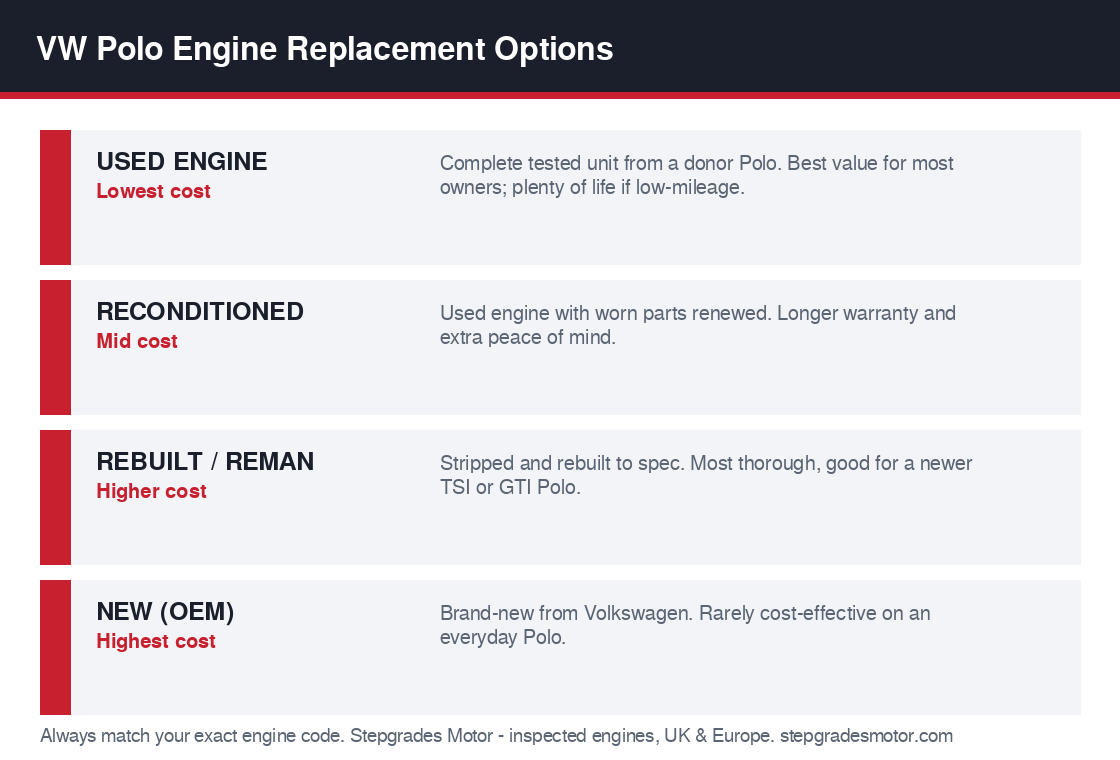
If diagnosis confirms you need a new engine, you have four main routes, each with different costs and trade-offs:
- Used (second-hand) engine — a complete, tested engine from a donor Polo. Usually the most cost-effective, with plenty of life if it’s a low-mileage import.
- Reconditioned engine — a used engine with worn parts renewed, typically with a longer warranty.
- Rebuilt/remanufactured engine — stripped and rebuilt to specification; the most thorough but priciest route.
- New (OEM) engine — rarely cost-effective for an everyday Polo.
For most Polo owners, a quality used or reconditioned engine offers the best balance of cost and reliability. A full comparison is in our guide on Überholte Motoren im Vergleich zu gebrauchten Motoren im Vergleich zu wiederaufgebauten Motoren.
How much does a VW Polo engine replacement cost?
There’s no single figure, because the cost depends on which engine your Polo has, the route you choose, and fitting. As a general pattern across Europe, a used Polo engine is the most affordable to buy, a reconditioned one costs more but adds peace of mind, and a rebuilt or new engine is dearest. To any of these you must add fitting labour, which varies by garage.
Because the Polo is so common, its engines are widely available and competitively priced — you’re not chasing a rare unit, except perhaps for a specific GTI engine. When comparing quotes, always weigh the total cost: the engine, delivery, what’s included (bare unit or with ancillaries), the warranty, and fitting. A cheap engine with no warranty and high shipping can cost more overall than a dearer, tested unit that arrives ready to fit. The Polo holds its value well, so a quality replacement engine is usually a very sound investment that keeps a desirable car on the road.
Common VW Polo engine problems to know
Knowing the Polo’s weak points helps you diagnose faults and choose a sound replacement. The most significant include:
- 1.2 TSI timing chain (Mk5): the chain and tensioner on early EA111 engines can wear, causing a cold-start rattle and, if ignored, a skipped chain and serious damage. Check whether the updated tensioner has been fitted, or whether the engine is a later belt-driven unit.
- Carbon build-up: direct-injection TSI engines can accumulate carbon on the intake valves, causing rough idle, hesitation and misfires — usually cured by cleaning.
- Oil consumption and PCV valve: some TSI engines consume oil, sometimes linked to a failed PCV valve or worn rings.
- Diesel DPF issues: the 1.4 and 1.6 TDI can suffer particulate-filter blockages, mostly on short-trip cars.
The takeaway is twofold: keep up with servicing and address warning signs early; and when buying a used Polo engine, check specifically for the known weak points of that variant. A low-mileage, well-maintained, inspected unit is far less likely to carry these problems forward.
Petrol or diesel VW Polo engine: what to replace with
Whichever engine your Polo has, a like-for-like replacement is the rule — you replace a petrol with the same petrol and a diesel with the same diesel, matched by engine code. But the type affects what to check. On a petrol Polo engine such as the 1.2 or 1.0 TSI, pay attention to timing-chain or belt condition, carbon build-up and any oil-consumption history, and — since most are turbocharged — the turbo, which we cover in our guide to the Autoturbocompressor. On a diesel Polo engine like the 1.6 TDI, the turbo, injectors and particulate filter matter most.
Diesel Polos suit higher-mileage drivers, while the petrols suit lower-mileage town use — a distinction we explore in our guide to Benzin- versus Dieselmotoren. When sourcing a replacement, make sure the unit matches not just the size but the exact fuel and specification of your original.
How to choose a used VW Polo engine
Choosing well is what makes a Polo engine replacement a success rather than a gamble. Keep these essentials in mind:
- Match the engine code exactly. VW used many closely related variants; the replacement must be the correct code for your specific car, year and specification — not just “a 1.2 TSI”. You’ll find the code on the engine and your vehicle papers.
- Choose a low-mileage, tested unit. Ask for compression or testing evidence, and for the 1.2 TSI, confirmation of the timing chain’s condition or that the updated parts are fitted.
- Confirm what’s included. Is it a bare engine, or does it include manifolds, injectors, turbo and ancillaries? You may need to transfer parts from your old engine.
- Buy from a reputable supplier who confirms fitment and offers a warranty.
For the full process, read our guides on So kaufen Sie einen gebrauchten Motor in Europa und So überprüfen Sie einen gebrauchten Motor, or browse our range of inspected Gebrauchtwagenmotoren.
Fitting a replacement VW Polo engine
Fitting a Polo engine is a job for a competent garage, and most warranties require professional installation — particularly important on a VW, where correct coding and electronics matter. Fitting is also the ideal time to renew service items that are cheaper to replace while the engine is out: the timing belt or chain, water pump, thermostat and relevant gaskets, which protects your new engine from day one.
Be clear with your fitter about what the replacement engine includes, so any ancillaries that need transferring from your old engine (such as the manifold, injectors, turbo or sensors) are accounted for. Using the correct oil and a new filter from the first start is usually a warranty condition. Done properly, a quality used Polo engine fitted by a good garage will give the same dependable service as a far more expensive option, at a fraction of the cost.
How long should a VW Polo engine last?
A well-maintained VW Polo engine can comfortably cover 120,000–150,000 miles or more, and the tougher diesels often go considerably further. VW engines are generally well-engineered and durable — what shortens their life is usually neglect rather than age: skipped oil changes, ignoring a rattling timing chain, carbon build-up left unaddressed, or overheating.
This is reassuring when buying a used replacement: a Polo engine from a well-cared-for, lower-mileage donor is very likely to have plenty of life left. It’s exactly why a compression test, a known service history, and confirmation of the timing chain’s condition add so much value, and why a low-mileage imported unit can be such a sound, long-lasting basis for your replacement.
Buying a VW Polo engine online across Europe
Most Polo engine purchases now begin online, giving you far more choice than your local area. Because the Polo is so common across the UK and Europe, sound used engines are widely available and competitively priced. Buy carefully: choose a seller who states the engine code and mileage, confirms fitment for your registration, provides testing evidence, offers a written warranty, and ships on secured, tracked pallet freight.
At Stepgrades Motor we deliver inspected engines across the UK and mainland Europe and confirm fitment for your exact vehicle before you order. If you’re unsure which engine your VW Polo needs, Senden Sie uns Ihre Anmeldung and we’ll identify the correct unit for you. Looking for a different model? See our companion guide on Vauxhall/Opel Corsa engine replacement.
Buying a Polo engine across Europe: country by country
The Polo sells strongly right across the continent, which is good news when sourcing a replacement — donor engines are plentiful almost everywhere. In Germany, the Polo’s home market, the TSI petrols and TDI diesels are everywhere, and German owners tend to keep meticulous service records. In Spain und Italy, the smaller petrols dominate city driving, so low-stress, lower-mileage units are common. In France, the diesels have long been popular with higher-mileage drivers. And across the UK, the Polo has been a best-selling supermini for decades, so both petrol and diesel engines are easy to find.
What matters is not where the engine comes from but its condition, mileage and exact code match. A well-maintained, tested, lower-mileage unit sourced and shipped properly will serve you just as well wherever it originated. At Stepgrades Motor we handle secured, tracked pallet delivery across the UK and mainland Europe, so you get the right engine for your Polo delivered safely to your door or your garage — without being limited to whatever happens to be available locally.
Why a used Polo engine is often the smart choice
It’s worth stepping back to see why so many Polo owners choose a used engine over the alternatives. The Polo is a genuinely good car that tends to stay desirable and hold its value, so when the engine is the only thing wrong, scrapping the whole vehicle makes little sense. A quality used engine lets you keep a car you already know and trust, avoids the cost, depreciation and paperwork of buying another, and — because Polo engines are so plentiful — comes at a sensible price.
The key, as throughout this guide, is to buy well rather than cheaply: a tested, low-mileage, correctly-coded unit with a warranty is a sound investment, whereas the cheapest no-questions-asked engine can be a false economy. Get that balance right and a used engine is very often the most sensible, cost-effective way to give a good Polo years of further, dependable life.
Your VW Polo engine buying checklist
Before you commit to any VW Polo engine replacement, run through this quick recap:
- ✅ You’ve diagnosed the fault properly and ruled out cheaper causes (coil packs, PCV valve, carbon build-up).
- ✅ You know your exact engine code and Polo generation.
- ✅ The replacement is matched to that code, fuel type and specification.
- ✅ It’s a low-mileage, tested unit, with the timing chain’s condition confirmed on 1.2 TSI engines.
- ✅ You know what’s included (bare engine or with ancillaries).
- ✅ There’s a clear written warranty and confirmed fitment for your registration.
- ✅ Tracked, palletised delivery to your location is arranged.
- ✅ You’ve budgeted for fitting and renewing service items while the engine is out.
Tick every box and your VW Polo engine replacement should be a smooth, cost-effective success.
Häufig gestellte Fragen
How much does it cost to replace a VW Polo engine?
Is it worth replacing the engine in a VW Polo?
What is the common timing chain problem on the VW Polo 1.2 TSI?
How do I know which engine my VW Polo has?
Should I choose a petrol or diesel replacement for my Polo?
Das Fazit
With so many Volkswagen Polos on Europe’s roads, engine replacement is a common and very manageable need — and because the Polo is a quality car that holds its value, it’s usually well worth doing. The keys are to diagnose the fault properly first (ruling out cheaper causes like coil packs and carbon build-up), then choose the right replacement. For most Polos, a quality low-mileage used engine offers the best balance of cost and reliability. Match the engine code exactly, check the known weak points like the 1.2 TSI timing chain, buy a tested unit from a reputable supplier, and have it fitted properly.
Ready to find the right engine for your VW Polo? Browse our inspected Gebrauchtwagenmotoren, lesen Sie unsere Ratgeber zu buying a used engine und checking a second hand engine, oder Kontaktieren Sie unser Team with your registration and we’ll confirm exactly which VW Polo engine your car needs.
 English
 Deutsch
 Français
 Italiano
 Español
 Nederlands
 Polski