
Blog
Engine Pistons Explained: Function, Failure Signs & Replacement

Deep inside every engine, a set of metal plungers hammers up and down thousands of times a minute, turning burning fuel into the force that drives your car. These are the engine pistons — among the hardest-working and most highly stressed parts in the whole machine. When they’re healthy you never think about them; when they wear or fail, the symptoms can be alarming and expensive. This guide explains what engine pistons are, what they do, how they fail, and what your options are when they do — in plain language for drivers across the UK and Europe.
Op Stepgrades-motor we import, inspect and supply engines to drivers and garages across Europe, and the condition of the pistons — measured through compression — is central to how we judge an engine’s health. By the end of this article you’ll understand exactly how engine pistons work, recognise the warning signs of trouble, and know why worn pistons usually mean it’s time for a replacement engine rather than a patch-up.
What are engine pistons?
An engine piston is a cylindrical metal component that slides up and down inside a cylinder in the engine block. Its job is to transfer the force of burning fuel into mechanical motion. When the fuel-air mixture ignites above the piston, the rapid expansion of gas pushes the piston down the cylinder with enormous force — and that push, repeated in each cylinder, is what ultimately turns your wheels.
Most car engines have one piston per cylinder, so a four-cylinder engine has four pistons, a six-cylinder has six, and so on. Each piston is connected by a connecting rod to the crankshaft, which converts the pistons’ up-and-down movement into the rotation that drives the car. Engine pistons are, in effect, where the engine’s power is born.
What does a piston do?
The piston performs several jobs at once, under extreme heat and pressure:
- Transfers combustion force. It captures the force of the burning fuel and passes it to the crankshaft via the connecting rod.
- Seals the combustion chamber. With its piston rings, it keeps the high-pressure combustion gases above the piston and the oil below.
- Compresses the mixture. On the way up, it squeezes the fuel-air mixture (or air, in a diesel) ready for ignition.
- Helps manage heat. It transfers some combustion heat to the cylinder walls and coolant.
Doing all this reliably, hundreds of times a second, for years on end, is why engine pistons are engineered to such fine tolerances — and why their wear directly affects an engine’s power, economy and health.
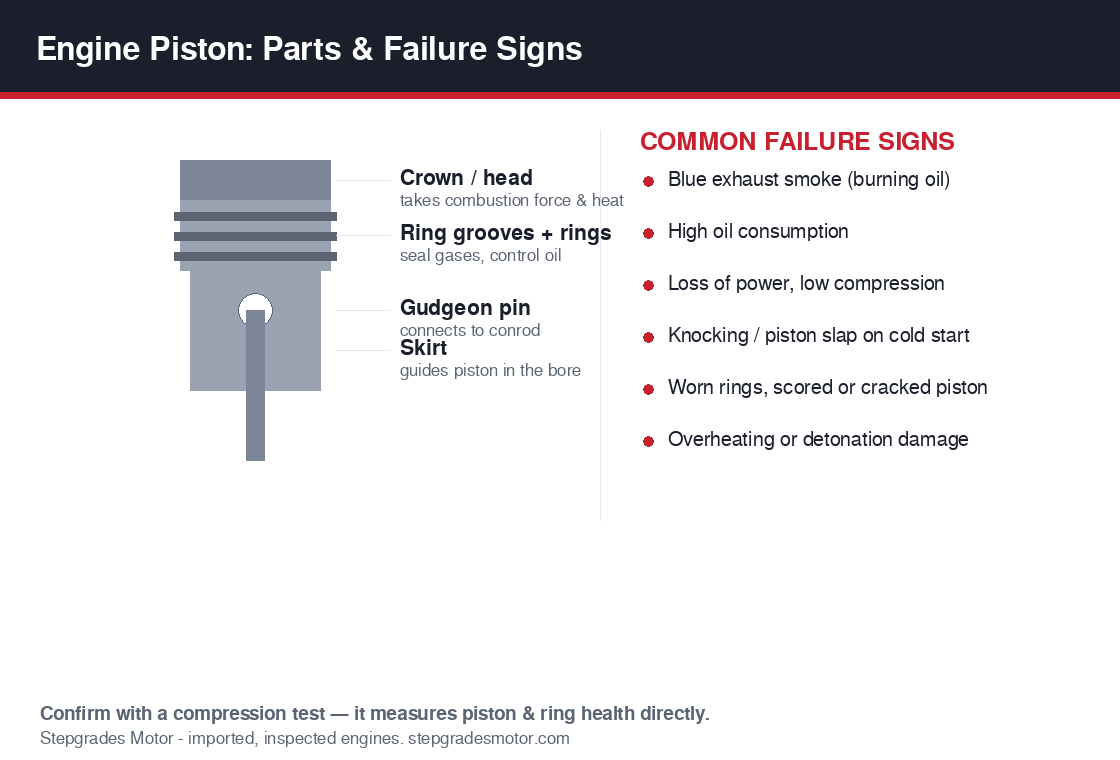
The parts of an engine piston
Though it looks simple, a piston has several distinct features, each with a purpose:
- Crown (or head) — the top face that takes the direct force and heat of combustion. It may be flat, domed or dished to suit the engine’s design.
- Ring grooves and lands — the channels around the piston that hold the piston rings.
- Piston rings — the sprung metal rings that seal against the cylinder wall (more on these below).
- Gudgeon pin (wrist pin) — the pin that connects the piston to the connecting rod, allowing it to pivot.
- Skirt — the lower section that guides the piston and stops it rocking in the bore.
Every one of these must stay within tight tolerances. Wear or damage to any of them — a worn ring groove, a scored skirt, a cracked crown — affects how well the piston seals and performs.
Piston rings explained
The piston rings deserve special attention, because they do much of the critical sealing work and are a common wear point. A typical piston carries three rings:
- Top compression ring — seals the combustion gases, keeping pressure above the piston.
- Second compression ring — provides additional sealing and helps control oil.
- Oil control ring — scrapes excess oil from the cylinder wall and returns it to the sump, stopping oil burning in the combustion chamber.
When piston rings wear, the engine loses compression and begins to burn oil — two of the clearest signs of an aging engine. Healthy rings are essential to power, economy and clean running. The video below shows how a piston and its rings work inside the cylinder.
How engine pistons work through the four strokes
To really understand engine pistons, it helps to see their role across the engine’s four-stroke cycle — the sequence every cylinder repeats hundreds of times a minute. On the intake stroke, the piston moves down the cylinder, drawing in air (and fuel in a petrol engine). On the compression stroke, it travels back up, squeezing that mixture into a small space ready for ignition.
Then comes the power stroke: the mixture ignites and the expanding gas drives the piston down hard — this is the moment the piston captures the engine’s power. Finally, on the exhaust stroke, the piston rises again to push the spent gases out. So in a single cycle the piston both does the work of compressing the mixture and harvests the energy of combustion. This relentless up-and-down motion, multiplied across every cylinder, is what the whole engine is built around — a process we cover in full in our guide on how a car engine works.
Petrol vs diesel pistons: what’s different?
Petrol and diesel engines both use pistons in the same basic way, but the pistons themselves differ because of how the two engines run. Diesel engines operate at much higher compression — they compress air hard enough to ignite the fuel without a spark — so their pistons must be stronger and more heat-resistant to cope with the far greater pressures and temperatures. Diesel pistons are often heavier, with a reshaped crown (frequently bowl-shaped) to help form the combustion chamber.
Petrol engine pistons are generally lighter, allowing the engine to rev more freely. Turbocharged petrol engines, which also run high pressures, often use stronger forged pistons for durability. These differences are part of why a diesel engine can’t simply be swapped for a petrol one, and why diesel engines tend to cost more to build and repair. Whatever the fuel, though, the piston’s fundamental job — seal, compress and transfer power — is the same.
What are engine pistons made of?
Most modern engine pistons are made from aluminium alloy, which is light and conducts heat well — important for a part that must move fast and shed combustion heat quickly. Lighter pistons also allow the engine to rev more freely and reduce stress on the crankshaft and bearings.
Pistons are made in two main ways. Cast pistons are poured into a mould and are economical and perfectly adequate for everyday engines. Forged pistons are formed under great pressure, making them stronger and better able to withstand the extreme heat and pressure of high-performance or heavily turbocharged engines. Whatever the method, the piston must be precisely machined and matched to its cylinder, with just the right clearance to seal well while allowing for expansion as it heats up.
Common engine piston problems
Because pistons work under such punishing conditions, they are subject to several well-known failures — most of them the result of heat, poor maintenance or extreme stress.
Worn piston rings
The most common piston-related issue. Over high mileage, the rings and ring grooves wear, reducing their seal. This lowers compression and lets oil slip past into the combustion chamber, causing the engine to burn oil and lose power.
Scored or scuffed pistons
Scratches and scuffing on the piston or cylinder wall, often caused by poor lubrication, overheating or debris, reduce the seal and accelerate wear.
Cracked or holed piston
Severe stress, detonation or overheating can crack a piston or even burn a hole through its crown — a catastrophic failure that usually destroys the engine’s compression in that cylinder.
Piston slap
When the clearance between piston and cylinder becomes too great (through wear or a cold engine), the piston rocks and “slaps” the cylinder wall, producing a distinctive knocking noise, especially on cold start.
Seized piston
A total loss of lubrication or severe overheating can cause a piston to expand and seize solid in the cylinder — an immediate, engine-ending failure.
Melted or burned piston
Persistent detonation (“pinking”) or running too lean can melt or burn the piston crown, especially on turbocharged engines. This is why correct fuelling and avoiding sustained knock matters so much.
Symptoms of worn or failing engine pistons
Piston problems usually announce themselves through a few tell-tale symptoms:
- Blue exhaust smoke — burning oil, a classic sign of worn rings letting oil into the combustion chamber.
- High oil consumption — needing to top up oil frequently.
- Loss of power and poor acceleration — from reduced compression.
- Knocking or slapping noises — especially on cold start, suggesting piston slap or damage.
- Rough running or misfiring — if a cylinder loses compression badly.
- Failed compression test — low or uneven readings across cylinders, the definitive measure.
Because several of these overlap with other faults, a compression or leak-down test is the reliable way to confirm whether the pistons and rings are the cause. Catching the signs early can prevent a worn engine from becoming a wrecked one.
What causes engine piston damage?
Most piston failures trace back to a handful of causes, nearly all preventable:
- Overheating — the biggest enemy, expanding and distorting pistons beyond their limits.
- Poor lubrication — low or dirty oil starving the piston and rings, causing scuffing and seizure.
- Detonation and pre-ignition — uncontrolled combustion (knock) hammering or melting the piston.
- Running too lean or over-boosting — often from tuning faults, raising temperatures dangerously.
- High mileage and age — gradual, normal wear of rings and bores over a long life.
- Debris or foreign objects entering the cylinder.
The lesson is familiar: look after the cooling and lubrication systems, use the correct fuel and oil, and don’t ignore knocking, and engine pistons will usually last the life of the engine.
Can you drive with a failing piston?
It’s risky and best avoided. Worn rings burning oil may let you continue for a while, but a cracked, holed or seizing piston can destroy the engine and leave you stranded, sometimes suddenly. Running an engine with serious piston damage also risks debris circulating and ruining other components. If you notice heavy blue smoke, rapid oil loss, a knocking noise or a sudden power loss, it’s safest to have it checked promptly rather than risk turning a repairable problem into a complete engine failure.
Piston repair vs engine replacement
When pistons or rings wear or fail, you technically have two routes: rebuild the engine’s internals or replace the whole engine. In theory, a workshop can strip the engine, re-bore the cylinders, and fit new pistons and rings. In practice, for the vast majority of everyday cars, replacing the complete engine is the more sensible choice.
A full internal rebuild is highly labour-intensive, requires specialist machining, and only makes sense if the rest of the engine — the block, crankshaft and head — is known to be in excellent condition. By contrast, fitting a complete, tested used or reconditioned engine is usually faster, more reliable and often cheaper overall, because you get a whole proven unit with sound pistons rather than paying for a rebuild around an uncertain core. For most cars with worn or damaged pistons, a quality replacement engine is the practical answer.
How to keep your engine’s pistons healthy
Pistons are among the most durable parts of a well-maintained engine, and a few habits keep them that way:
- Change the oil on schedule with the correct grade — clean oil protects the rings and bores.
- Keep the cooling system healthy and never ignore overheating.
- Use the correct fuel and address any knocking or pinking promptly.
- Let the engine warm up gently before hard driving, so clearances and oil are up to temperature.
- Avoid unnecessary over-tuning that pushes pistons beyond their design limits.
Treat the pistons well through good basic maintenance and they’ll reward you with years of reliable compression and power.
How long do engine pistons last?
Engine pistons are not a scheduled service item like a timing belt — they’re designed to last the life of the engine, and in a well-maintained car that can mean hundreds of thousands of miles. The pistons themselves are extremely durable; what gradually wears is the sealing surfaces, chiefly the piston rings and the cylinder bores, over very high mileage.
What shortens piston life is almost never gentle age — it’s abuse or neglect. Overheating, running low on oil, persistent knock or aggressive tuning can damage pistons in a fraction of the time that normal use would. This is reassuring for anyone buying a used engine: a unit from a well-cared-for, low-mileage donor is very likely to have pistons with plenty of life left, which is exactly why a compression test — the direct measure of piston and ring health — is such an important check before buying.
Is it really the pistons? Telling the cause apart
Because the symptoms of worn pistons overlap with other faults, it’s worth knowing how to tell them apart before assuming the worst. Blue smoke and oil burning can come from worn piston rings, but also from worn valve stem seals or a failing turbo — so the source needs checking. Low power can be pistons and rings, but also a blocked exhaust, a boost leak or ignition problems. A knocking noise might be piston slap, but could equally be worn bearings or other components.
This is exactly why a compression test (and, for more detail, a leak-down test) is so valuable: it isolates how well each cylinder’s piston, rings and valves are sealing, separating genuine piston wear from cheaper, unrelated faults. A methodical mechanic will confirm the cause this way before recommending major work — and so should you before deciding between a repair and a replacement engine.
Pistons, compression and buying a replacement engine
Understanding engine pistons pays off directly when you need a replacement engine, because the health of the pistons and rings is exactly what a compression test measures. When choosing a used or reconditioned engine:
- Insist on compression or leak-down test results — these reveal how well the pistons, rings and valves are sealing.
- Choose a low-mileage unit from a sound donor, where the pistons have plenty of life left.
- Match the engine code exactly to your vehicle.
- Buy from a reputable supplier who inspects and warranties units.
A tested engine with healthy pistons is the foundation of years of dependable motoring. To go further, read our guides on how to check a second hand engine, Uitleg over auto-onderdelen en what an engine block is, or browse our range of inspected motoren van tweedehands auto’s. If you’re unsure which engine your car needs, send us your registration and we’ll confirm it.
Frequently asked questions
What is the function of engine pistons?
What are the symptoms of worn engine pistons or rings?
What causes a piston to fail?
Can I drive with a bad piston?
Should I replace the pistons or the whole engine?
The bottom line
Engine pistons are where your engine’s power begins — hard-working metal plungers that turn burning fuel into motion while sealing the combustion chamber under extreme heat and pressure. Their health, measured through compression, largely determines an engine’s power, economy and smoothness. Most piston failures come down to overheating, poor lubrication or knock, and are preventable with good maintenance. But when pistons or rings wear out, a complete, tested replacement engine is almost always a better bet than an expensive internal rebuild.
If worn pistons mean you need a replacement engine, focus on compression-tested, low-mileage units from a reputable supplier. Browse our inspected motoren van tweedehands auto’s, read our companion guides on car engine parts en how a car engine works, of contact our team with your registration and we’ll help you find the right engine for your vehicle.
 English
 Deutsch
 Français
 Italiano
 Español
 Nederlands
 Polski