
Blog
Hoe een automotor werkt: een eenvoudige, uitgebreide handleiding

Every time you turn the key or press the start button, thousands of precisely timed events begin happening inside your engine, several hundred times a second. It’s one of the most remarkable machines most of us use every day — yet very few drivers could explain it. So how does an engine work, really? This guide breaks it down in plain language, from the fuel in your tank to the wheels turning on the road, with no engineering degree required.
Op Stepgrades-motor we supply imported, inspected engines to drivers and garages across the UK and mainland Europe, and we’re firm believers that understanding how your engine works makes you a better, more confident car owner — especially if you ever need to replace one. By the end of this article you’ll understand the four-stroke cycle, the main parts involved, how petrol and diesel engines differ, and how all that power actually reaches the road.
How does an engine work? The simple answer
At its heart, a car engine is a machine that turns fuel into movement by burning it in a controlled way. It takes a mixture of fuel and air, compresses it, ignites it to create a small, powerful expansion of gas, and uses that force to push a piston. That linear push is then converted into the spinning motion that ultimately turns your wheels. Do this thousands of times a minute across several cylinders and you have smooth, continuous power.
In other words, a car engine is a type of internal combustion engine: “internal” because the fuel is burned inside the engine itself, and “combustion” because that burning — a series of tiny, contained explosions — is what creates the energy. Everything else in the engine exists to make those explosions happen at exactly the right moment, capture their energy efficiently, and keep the whole process cool, lubricated and repeating reliably.
The core idea: turning fuel into motion
To really understand how an engine works, picture the basic chain of events. Fuel and air are mixed and drawn into a sealed chamber called a cylinder. A piston inside that cylinder squeezes the mixture into a small space, which makes it far more powerful when it ignites. A spark (in a petrol engine) or intense heat from compression (in a diesel) sets it off, and the resulting expansion forces the piston downward with considerable energy.
That downward push is the useful work. The piston is connected to a crankshaft, which converts the up-and-down motion of the pistons into rotation — the same way your legs pushing up and down turn the pedals and wheel of a bicycle. That rotation is the engine’s output, and from there it travels through the gearbox and driveshafts to turn the wheels. The genius of the design is repetition and timing: by staggering this process across multiple cylinders, the engine delivers smooth, continuous power rather than a single jolt.
What happens the moment you start your engine
Before the four-stroke cycle can run on its own, the engine needs a push to get going — and that’s where starting the car comes in. When you turn the key or press the start button, a small but powerful electric motor called the starter motor spins the engine’s crankshaft for you. This cranking turns the pistons and begins drawing fuel and air into the cylinders, getting the first few cycles underway.
At the same time, the fuel system delivers fuel and, in a petrol engine, the ignition system fires the spark plugs. As soon as the first cylinders start producing their own power strokes, the engine “catches” and begins running under its own power. The starter motor disengages, the engine settles into a steady idle, and from that point the four-stroke cycle sustains itself — each power stroke keeping the crankshaft spinning to drive the next. All of this happens in a fraction of a second, every time you start your car.
The main parts that make it happen
You don’t need to know every component to understand how an engine works, but a handful of key parts do the heavy lifting:
- Cylinders — the sealed chambers where combustion happens. Most cars have three, four or six.
- Pistons — tight-fitting plugs that slide up and down inside each cylinder, driven by the expanding gas.
- Crankshaft — converts the pistons’ up-and-down motion into rotation.
- Connecting rods — link each piston to the crankshaft.
- Valves — let the fuel-air mixture in and the exhaust gases out at the right moments.
- Spark plugs (petrol engines) — provide the spark that ignites the mixture.
- Camshaft and timing belt or chain — keep the valves opening and closing in perfect time with the pistons.
These parts work together in a carefully choreographed sequence. The real magic is in the timing — and that sequence has a name: the four-stroke cycle.
The four-stroke cycle explained
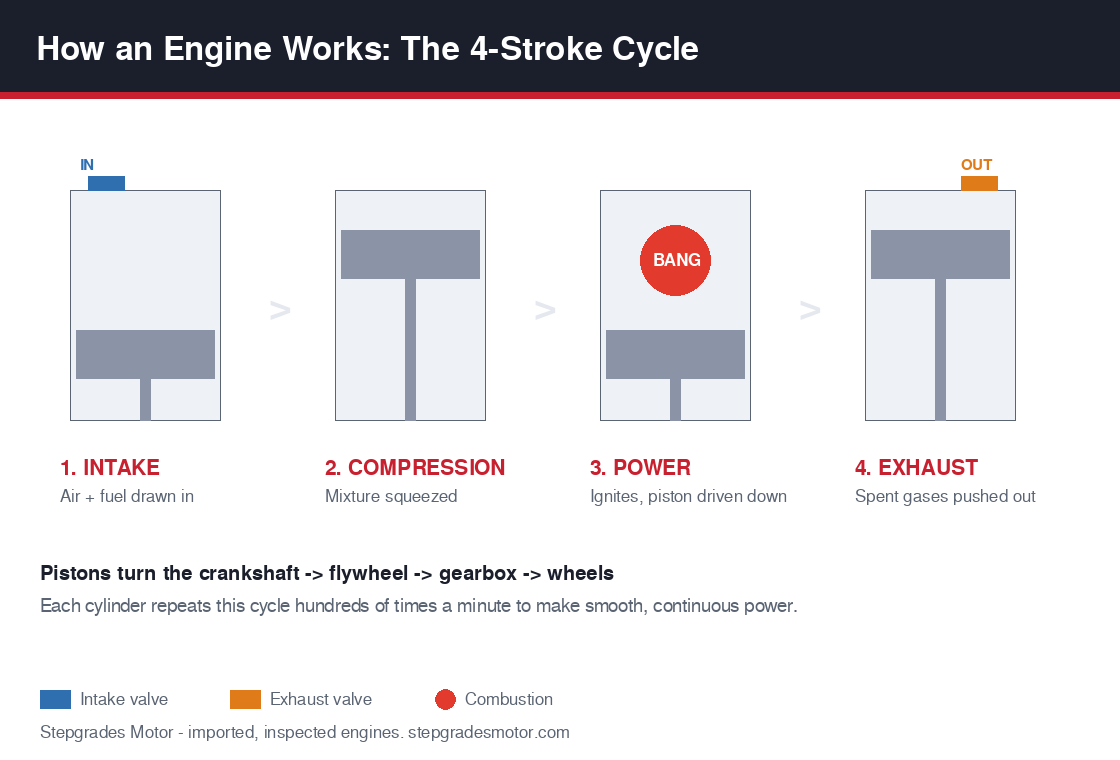
Almost every modern car engine is a “four-stroke” engine, meaning each cylinder completes its job in four distinct movements, or strokes, of the piston. Understanding these four steps is the key to understanding how an engine works. Here’s what happens in each cylinder, over and over.
1. Intake stroke
The piston moves down the cylinder, and the intake valve opens. As the piston descends it creates a vacuum that draws in a fresh charge of air — mixed with fuel in a petrol engine, or just air in most modern diesels. Think of it as the cylinder taking a breath.
2. Compression stroke
The intake valve closes and the piston travels back up, squeezing the trapped mixture into a tiny space at the top of the cylinder. This compression is crucial: the more tightly the mixture is squeezed, the more powerful the burn will be. In a diesel engine, this compression alone generates enough heat to ignite the fuel.
3. Power (combustion) stroke
This is the moment that produces the engine’s power. In a petrol engine, the spark plug fires and ignites the compressed mixture; in a diesel, fuel is injected into the superheated compressed air and ignites instantly. The rapid expansion of burning gases forces the piston powerfully downward — and that push is the energy that ultimately drives your car.
4. Exhaust stroke
The piston rises again, the exhaust valve opens, and the spent gases are pushed out of the cylinder and away through the exhaust system. Once the cylinder is cleared, the exhaust valve closes, the intake valve opens, and the whole four-stroke cycle begins again — hundreds of times every minute.
These four strokes — often remembered as “suck, squeeze, bang, blow” — repeat continuously in every cylinder. The animation below shows the complete cycle in motion, which makes the whole process much easier to picture.
From piston to wheels: how the power reaches the road
Understanding combustion is only half the story — the engine still has to deliver that power to the wheels. Here’s how the energy travels. Each piston’s downward push turns the crankshaft, a cleverly bent steel shaft that converts the straight-line motion into smooth rotation. Because the cylinders fire one after another in a set order, the crankshaft receives a steady stream of pushes and keeps spinning evenly.
At the end of the crankshaft sits the flywheel, a heavy disc that smooths out the pulses and keeps the engine turning steadily between power strokes. From there the rotation passes through the clutch (or torque converter in an automatic) into the gearbox, which multiplies or reduces the turning force to suit your speed. Finally, the driveshafts carry that rotation to the wheels, and your car moves. The diagram below summarises the four-stroke cycle and how it keeps the crankshaft turning.
Petrol vs diesel: how the working differs
Petrol and diesel engines both use the four-stroke cycle, but they ignite their fuel in fundamentally different ways — and that single difference shapes how each one behaves. A petrol engine mixes fuel and air, compresses it, and ignites it with a spark from the spark plug. This is called spark ignition. Petrol engines rev freely and smoothly, which suits lighter, faster cars.
A diesel engine, by contrast, compresses only air — and compresses it much harder. That intense compression heats the air so much that when diesel fuel is injected, it ignites on its own without any spark. This is called compression ignition. The higher compression makes diesels more efficient and gives them more low-down pulling power, which is why they’re favoured for heavier vehicles and long-distance motorway driving across Germany, France, Belgium and the Netherlands. Neither is simply “better” — each suits different needs, a topic we explore further in our other engine guides.
Cylinder layouts: how engines are arranged
The cylinders in an engine can be arranged in several ways, and the layout affects how the engine feels, sounds and fits under the bonnet. The most common in everyday European cars is the inline engine, where the cylinders sit in a single row — simple, compact and economical to build, which is why most three- and four-cylinder cars use it.
When more cylinders are needed, a V layout places two banks of cylinders at an angle to each other, forming a V shape. This keeps a six- or eight-cylinder engine shorter and is common in larger and more powerful cars. A few manufacturers use a flat (or “boxer”) layout, where the cylinders lie horizontally opposed, which lowers the engine’s centre of gravity. Whatever the arrangement, each cylinder still runs exactly the same four-stroke cycle — the layout simply changes how they’re packaged and how the power is delivered.
Why precise timing matters so much
If there’s one thing that makes an engine work rather than simply seize, it’s timing. For every cylinder, the valves must open and close, and the spark must fire, at exactly the right fraction of a second relative to the piston’s position. Open a valve at the wrong moment, or fire the spark too early or too late, and the engine loses power, runs roughly, or won’t run at all.
This precision is managed by the camshaft, driven from the crankshaft by a timing belt or timing chain so that the valves always move in perfect step with the pistons. It’s also why a snapped timing belt is so serious: if the belt fails, the valves and pistons can collide and cause major internal damage. That’s exactly why replacing the timing belt on schedule is one of the most important services your engine will ever receive — and why it’s always renewed when a replacement engine is fitted.
The supporting systems that keep an engine running
The four-stroke cycle doesn’t happen in isolation. Several supporting systems work constantly to keep combustion clean, controlled and sustainable:
- Fuel system — stores fuel and delivers it to the cylinders in precisely the right amount.
- Ignition system — in petrol engines, generates and times the spark.
- Cooling system — circulates coolant to stop the engine overheating, since combustion generates enormous heat.
- Lubrication system — pumps oil around the moving parts to reduce friction and wear.
- Exhaust system — carries spent gases away and reduces harmful emissions through the catalytic converter or particulate filter.
When people ask how an engine works, these systems are the unsung heroes. A fault in any one of them — a cooling leak, worn oil, a failing sensor — can stop even a healthy engine in its tracks, which is why regular servicing matters so much.
What makes one engine more powerful than another?
If every engine follows the same four-stroke cycle, why are some far more powerful than others? A few factors make the difference. The first is size, or displacement — the total volume swept by all the pistons. A larger engine burns more fuel and air per cycle, producing more power. The second is the number of cylinders: more cylinders generally mean smoother, stronger output.
The third major factor is forced induction. A turbocharger or supercharger forces extra air into the cylinders, letting the engine burn more fuel and make more power from the same size — which is why a small modern turbocharged engine can match a much larger older one. Engine design, fuel quality and how freely the engine can breathe through its intake and exhaust all play their part too. But the underlying principle never changes: more air and fuel burned efficiently equals more power.
Where does all the energy go?
One surprising fact about how an engine works is that only a fraction of the energy in your fuel actually reaches the wheels. In a typical petrol engine, roughly a quarter to a third of the fuel’s energy becomes useful motion; the rest is lost mainly as heat — through the exhaust and the cooling system — and to friction between moving parts. Diesel engines do a little better, which is part of why they use less fuel for the same work.
This is why the cooling and lubrication systems are so important: they manage the enormous heat and friction that combustion creates. It’s also why engineers work so hard on efficiency, using turbochargers, better fuel injection and lighter components to extract more useful work from every drop of fuel. Understanding this helps explain why a well-maintained engine with clean oil and a healthy cooling system runs more efficiently — and lasts longer — than a neglected one.
Why engines wear out — and what tends to fail
An engine is a mass of metal parts moving at high speed under heat and pressure, so wear is inevitable over time. Knowing the common failure points helps you understand both maintenance and the value of a quality replacement. Piston rings and cylinder walls gradually wear, reducing compression and power. Valves and valve seals can leak. Head gaskets can fail, allowing oil and coolant to mix. Timing belts perish and must be replaced on schedule to avoid catastrophic damage.
Most of these problems are accelerated by neglect — skipped oil changes, overheating, or ignoring warning signs. Looked after properly, a modern engine can cover very high mileages. But when an engine does reach the end of its reliable life, fitting a sound replacement is usually far cheaper than scrapping the whole car, and it gives a vehicle you already know a second lease of life.
How knowing this helps when you need a replacement engine
Understanding how an engine works isn’t just interesting — it’s genuinely useful when something goes wrong. If you know what the main parts do and how they fail, you can have a much more informed conversation with your mechanic, judge whether a repair or a replacement engine makes more sense, and spot a good deal from a bad one.
When the time comes to replace an engine, the same knowledge helps you buy wisely: you’ll understand why matching the exact engine code matters, why compression and testing are the key measures of health, and why a low-mileage unit from a sound donor is such good value. If you’d like to go further, read our guides on how to buy a used engine in Europe en how to check a second hand engine before you buy. And if you already know you need a replacement, you can browse our range of inspected motoren van tweedehands auto’s or contact our team with your registration for advice.
Frequently asked questions
How does a car engine work, in simple terms?
What are the four strokes of an engine?
What is the difference between how a petrol and a diesel engine work?
What turns the engine’s power into movement?
Why do car engines eventually need replacing?
The bottom line
So, how does an engine work? It burns fuel and air inside sealed cylinders in a precisely timed four-stroke cycle — intake, compression, power and exhaust — turning thousands of tiny controlled explosions into the smooth rotation that drives your wheels. Petrol and diesel engines achieve this slightly differently, and a host of supporting systems keep it all running cool, lubricated and reliable. Once you grasp that core idea, the whole machine suddenly makes sense.
And that understanding pays off in the real world: it makes you a more confident car owner, a sharper judge of repair quotes, and a smarter buyer if you ever need a replacement. If that day comes, browse our inspected motoren van tweedehands auto’s, read our guide on buying a used engine in Europe, of neem contact op with your registration and we’ll help you find the right engine for your car.
 English
 Deutsch
 Français
 Italiano
 Español
 Nederlands
 Polski