
Blog
Second Hand Engines: How to Check Quality Before You Buy

Een second hand engine is one of the smartest ways to keep a car on the road without paying for an expensive new unit — but only if the engine you buy is genuinely sound. The difference between a bargain that lasts for years and a costly mistake almost always comes down to one thing: how carefully the engine was checked before money changed hands. This guide walks you through exactly how to assess the quality of a second hand engine, step by step, whether you’re inspecting one in person or buying from a specialist online.
Op Stepgrades-motor we import, inspect and ship second hand engines to drivers and garages across the UK and mainland Europe, so we see every day what separates a good used unit from a risky one. By the end of this article you’ll know the precise checks to make, the red flags that should stop you, and the questions to ask any seller — so you can buy with real confidence, whether your car is a Volkswagen in Germany, a Peugeot in France, a Vauxhall in Britain or a Fiat in Italy.
What is a second hand engine — and why quality varies so much
A second hand engine is a complete engine removed from a donor vehicle and resold for use in another car of the same specification. Unlike a reconditioned or rebuilt unit, it is sold in largely the condition it left the donor vehicle — cleaned, inspected and ideally tested, but not internally overhauled. That’s precisely why it offers such good value: you’re buying a proven, working engine rather than paying for machining and new parts you may not need.
The catch is that no two second hand engines are identical. One may have come from a low-mileage car written off after a minor accident; another may have been pulled from a tired, high-mileage vehicle at the end of its life. Both can be advertised simply as “used” — so the burden is on you to check quality rather than trust the label. If you want the bigger-picture buying process first, our companion guide on how to buy a used engine in Europe covers sourcing, pricing and fitting; this article focuses specifically on judging quality before you commit.
It also helps to know how a used unit compares with the alternatives. If you’re weighing a straight used engine against a refreshed one, our explainer on reconditioned versus used versus rebuilt engines sets out the differences in work, warranty and cost.
Before you inspect: get the right engine code
Quality checks are pointless if the engine won’t fit your car in the first place, so this is step zero. Modern manufacturers produce many engine variants under the same model name, and they are not interchangeable. A “1.6 diesel” might exist in several incompatible versions with different mounts, wiring, emissions equipment and performance.
Find your engine code before you look at a single second hand engine. It’s usually stamped on the engine block itself and referenced in your vehicle documents — in the UK on your V5C registration certificate, and on the equivalent papers in other European countries. Match that code exactly to any engine you’re considering. A perfect, low-mileage unit of the wrong code is worthless to you; a correctly coded one is the only candidate worth inspecting.
How to check a second hand engine: the 10-point quality inspection
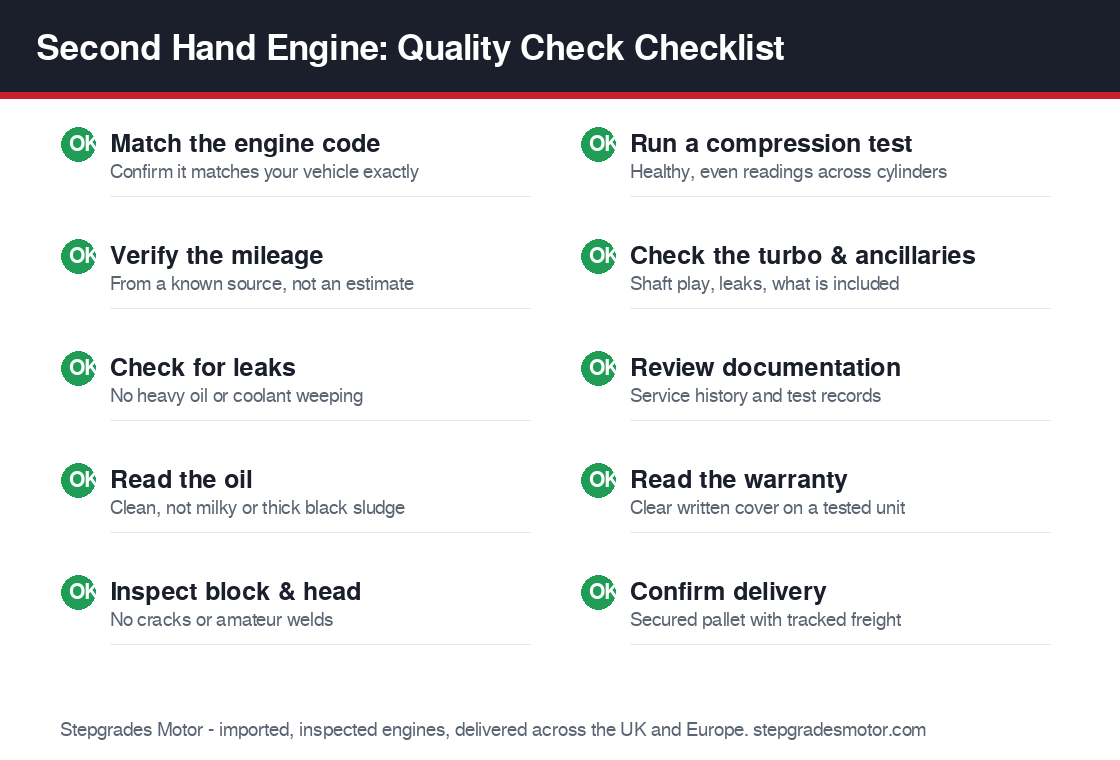
Once you’ve confirmed the engine code matches your vehicle, work methodically through these checks. In person you can do all of them; online you’ll ask the seller to confirm each one with evidence. Treat any check the seller can’t or won’t answer as a warning sign. The infographic below summarises the full inspection at a glance.
1. Confirm the engine code and recorded mileage
Re-read the code physically on the block and compare it with what was advertised. Then establish the mileage: a genuine low-mileage second hand engine is the single biggest factor in long service life. Ask how the mileage was verified — ideally from the donor vehicle’s history rather than an estimate. Be realistic, too: a 60,000-mile engine from a well-maintained car is usually a better buy than a 30,000-mile unit of unknown origin.
2. Inspect for oil and coolant leaks
Look over the whole exterior for oil weeping from gaskets and seals, and for coolant staining around the head, water pump and hoses. A little surface oil film is normal on a used engine; wet, dripping leaks or heavy crusted residue suggest failing gaskets or seals that will cost you after fitting. Pay particular attention to the join between the cylinder head and block — staining there can hint at head-gasket trouble.
3. Check the oil and look for sludge
Pull the dipstick and the oil filler cap. Clean, golden-to-brown oil is a good sign. A milky, mayonnaise-like residue on the cap or dipstick can indicate coolant mixing with the oil — a classic symptom of a blown head gasket or cracked head. Thick black sludge points to poor maintenance and neglected oil changes, which shortens an engine’s life. On a second hand engine, the oil tells you a lot about how the donor car was cared for.
4. Examine the block and cylinder head for cracks
Inspect the engine block and cylinder head carefully for cracks, welds or signs of previous repair, especially around the bores, water jackets and mounting points. Hairline cracks can be hard to spot but are a deal-breaker. Any sign that the engine has been in a serious impact — bent brackets, damaged castings — warrants extra caution.
5. Read the spark plugs or glow plugs
If accessible, removing a plug tells a story. A light tan or grey colour suggests healthy combustion. Heavy black sooting, oily deposits or a glazed white appearance can indicate running problems, oil burning or overheating in the donor engine. On a diesel, the condition of the glow plugs and injectors is equally revealing.
6. Run a compression test
A compression test is the most informative single check you can perform on a second hand engine, because it measures how well each cylinder actually seals. Low or uneven readings between cylinders point to worn piston rings, valves or a head-gasket problem — faults you can’t see from the outside. The short video below shows the correct technique and how to read the results.
You’re looking for healthy pressure in every cylinder and, crucially, consistency between them — a large gap between the highest and lowest cylinder is more worrying than the absolute figure. A reputable seller will have compression-tested the unit and can share the results, which is why we recommend always asking for them.
7. Consider a leak-down test
Where a compression test tells you that a cylinder is leaking, a leak-down test tells you where. By pressurising each cylinder and listening for where the air escapes — the exhaust, the intake, the crankcase or the coolant — a mechanic can pinpoint worn rings, burnt valves or a failing head gasket. It takes more skill and equipment, but for a higher-value engine it’s worth arranging.
8. Check the turbocharger, if fitted
Many modern petrol and diesel engines are turbocharged, and the turbo is a common and expensive failure point. If the second hand engine comes with its turbo, inspect it for shaft play, oil leaks and damaged vanes, and ask whether it was tested. A tired turbo can undo the value of an otherwise sound engine, so confirm its condition separately. Our guide to used engines notes which units commonly include ancillaries.
9. Inspect ancillaries, belts and wiring
Establish exactly what’s included. Does the engine come as a bare unit, or with its manifolds, injectors, sensors, wiring loom and ancillaries? Check the condition of any included timing belt or chain, and note that a timing belt should almost always be renewed on fitting regardless of its apparent condition. Missing or damaged sensors and connectors can add cost and delay, so a clear inventory is part of judging value.
10. Review service history and documentation
Finally, ask what’s known about the donor vehicle. A documented service history, proof of the mileage, and inspection or test records all add confidence. The more a seller can tell you about where a second hand engine came from and how it was checked, the lower your risk. A complete paper trail is itself a mark of quality.
How to check a second hand engine you can’t physically inspect
Most engine purchases across Europe now happen online, which gives you far more choice than your local area — but means you can’t put your hands on the unit before buying. That makes the seller’s checks, not your own, the deciding factor, so choose the seller as carefully as the engine.
- Insist on the engine code and mileage in writing for the exact unit you’re buying, and ask the seller to confirm fitment for your registration before you pay.
- Ask for inspection and compression-test evidence. A genuine specialist inspects and tests units as a matter of course and will share photographs and results without hesitation.
- Request clear photographs of the block, head, mounting points and any included ancillaries — not just a stock image.
- Get the warranty and exactly what’s included in writing before committing.
- Check how the engine will be delivered — a heavy unit must travel on a secured pallet with tracked freight.
Buy from a seller who volunteers this information and you remove most of the risk of buying unseen. If a listing is vague about the code, mileage or testing, treat that as your answer and look elsewhere. Browse our inspected second hand engines to see the level of detail a specialist supplier should provide.
Petrol vs diesel: what changes when checking a second hand engine
The core inspection is the same for both, but the emphasis shifts. Diesel engines run at far higher compression and carry extra high-pressure components, so there’s more to check — and more that can be expensive to put right.
On a second hand diesel engine, pay special attention to the turbocharger, the injectors and the exhaust-gas-recirculation and particulate-filter hardware, as these are costly to replace and common sources of trouble on high-mileage cars. Diesels are popular across Germany, France, Belgium and the Netherlands precisely because they cover big motorway miles — which also means careful checking of those ancillaries is essential. On a petrol engine, your focus is more on compression, the condition of the ignition components, and oil-burning symptoms. In both cases a compression test remains the key quality indicator.
Red flags: warning signs of a poor second hand engine
Some findings should make you walk away, or at least negotiate hard. Treat the following as serious warning signs:
- Milky residue on the oil cap or dipstick — possible head-gasket or cracked-head failure.
- Visible cracks or amateur welds on the block or cylinder head.
- Heavy, wet oil or coolant leaks rather than a light surface film.
- Low or wildly uneven compression between cylinders.
- Thick black sludge under the oil cap, indicating neglected maintenance.
- A seller who won’t confirm the engine code, mileage or testing, or who offers no warranty at all.
- A price that seems far too good to be true — it usually reflects a high-mileage or problem unit.
None of these guarantees disaster on its own, but each one shifts the odds against you. The more red flags, the further you should run.
Mileage, age and what “good condition” really means
Buyers often fixate on mileage alone, but context matters more than the raw number. An engine that has covered steady motorway miles with regular servicing can be in far better health than a low-mileage unit from a neglected, stop-start city car. When judging a second hand engine, weigh mileage alongside the oil condition, the service evidence and the compression results rather than treating any single figure as the whole story.
Age plays a part too. Parts such as rubber seals and plastic components can harden over many years regardless of mileage, which is one more reason to renew seals, gaskets and the timing belt on fitting. “Good condition” ultimately means an engine that seals well, shows no signs of overheating or contamination, comes from a known source and is backed by a warranty — not simply one with a low number on the clock.
Warranty: what it tells you about quality
A warranty isn’t just after-sales protection — it’s a signal of how confident the seller is in the engine. A supplier who inspects and tests units is willing to stand behind them; one who sells “as seen” with no cover is quietly telling you they aren’t sure. When assessing a second hand engine, read the warranty carefully:
- How long does it last, and what exactly does it cover?
- Does it require professional fitting and the correct oil to stay valid?
- What’s the process if something goes wrong after fitting?
A clear, fair warranty on a tested unit is one of the strongest quality indicators you can get. At Stepgrades Motor every engine is inspected before dispatch and covered by our standard guarantee, and we confirm fitment for your exact vehicle before you order.
Checking delivery and packaging across Europe
Quality doesn’t end at inspection — an engine damaged in transit is no bargain. A second hand engine is heavy and must travel on a secure pallet with proper strapping and tracked freight. Before buying, confirm how the unit will be packed and shipped to your country, and check it carefully on arrival.
When your engine is delivered, inspect the packaging and the unit before signing. Note any visible damage to the pallet or engine on the delivery paperwork, and photograph anything that concerns you. A professional supplier dispatches engines securely across the UK and mainland Europe and will expect you to check the delivery — it’s part of a proper transaction, not a sign of distrust. If you need a matching gearbox or transmission as well, ordering both from one supplier avoids compatibility and shipping headaches.
Your second hand engine quality checklist
Before you commit to any second hand engine, run through this quick recap to be sure you’re buying quality rather than a gamble:
- ✅ The engine code matches your vehicle exactly
- ✅ The mileage is verified and comes from a known source
- ✅ There are no heavy oil or coolant leaks, and the oil is clean (no milky residue or sludge)
- ✅ The block and head show no cracks or amateur repairs
- ✅ A compression test shows healthy, even readings across cylinders
- ✅ The turbo and ancillaries (if included) have been checked
- ✅ You know exactly what’s included — bare unit or with manifolds, loom and sensors
- ✅ There is a clear written warranty on a tested unit
- ✅ Tracked, palletised delivery to your country is arranged
Tick every box and you can be confident the second hand engine you’re buying is a quality unit that will give years of reliable service.
Common myths about checking a second hand engine
- “Low mileage always means good quality.” Not true — a well-maintained higher-mileage engine often beats a neglected low-mileage one. Condition and history matter as much as the number.
- “You can judge an engine just by looking at it.” A visual check is essential but incomplete; a compression test reveals internal problems the eye can’t see.
- “Buying online means you can’t check quality.” You can — by choosing a seller who inspects, tests and documents each unit, and shares the evidence.
- “A second hand engine won’t last.” A properly checked, correctly fitted used engine from a sound donor can last for many years and tens of thousands of miles.
Frequently asked questions
How do I check the quality of a second hand engine before buying?
What mileage is good for a second hand engine?
Is a compression test necessary when buying a used engine?
What are the warning signs of a bad second hand engine?
Can I safely buy a second hand engine online in Europe?
The bottom line
A second hand engine can be excellent value — but only when its quality is properly checked. Start by matching the engine code to your car, then work through the inspection: look for leaks, read the oil, examine the block and head, and above all confirm healthy, even compression. When buying online, let the seller’s inspection and testing do the work your own hands can’t, and insist on evidence, a clear warranty and secure delivery. Follow that process and you’ll separate a genuine bargain from an expensive mistake every time.
Ready to find a quality second hand engine for your car? Browse our inspected motoren van tweedehands auto’s, read our full guide on buying a used engine in Europe, of contact our team with your registration and we’ll confirm the right unit for your vehicle and budget.
 English
  Deutsch
  Français
  Italiano
  Español
  Nederlands
  Polski