
Blog
¿Qué es un bloque de motor? Tipos, averías y sustitución

Of all the parts in a car, none is more fundamental than the engine block. It’s the single largest, heaviest component of the engine — the foundation that everything else is built on. When people talk about engine blocks, they’re talking about the very backbone of the motor, and understanding it tells you a great deal about an engine’s health and value. This guide explains what the engine block is, what it does, the materials and types, the ways it can fail, and what to do when it does — in plain language for drivers across the UK and Europe.
En Motor Stepgrades we import, inspect and supply engines to drivers and garages across Europe, and the condition of the block is the first thing we assess, because a sound block is the heart of a sound engine. By the end of this article you’ll understand why engine blocks matter so much, how to recognise block problems, and why a cracked or worn block usually means it’s time for a replacement engine rather than a repair.
What is an engine block?
The engine block, also called the cylinder block, is the large metal casting that forms the main structure of the engine. Its primary job is to house the cylinders — the bores in which the pistons travel up and down — and to provide a rigid, precisely machined framework for all the other components. It’s the biggest and heaviest single part of the engine, and effectively the body to which everything else attaches.
Because the block is so large and strong, it makes an ideal mounting point for many other parts: the cylinder head bolts to the top, the crankshaft sits in the bottom, and the alternator, water pump, starter motor and other ancillaries bolt to the outside. In short, engine blocks are the structural core that holds the entire engine together and keeps every moving part in precise alignment.
What does the engine block do?
The engine block does far more than just hold the cylinders. Its key functions include:
- Housing the cylinders where combustion happens and the pistons move.
- Supporting the crankshaft in the strongest bearings in the engine, keeping it perfectly aligned.
- Containing coolant passages (water jackets) that carry coolant around the cylinders to manage heat.
- Containing oil galleries that route lubricating oil to the moving parts.
- Providing a mounting structure for the cylinder head, sump, ancillaries and engine mounts.
All of this has to be held to extremely tight tolerances, because the pistons, crankshaft and bearings depend on the block’s precise dimensions to work correctly. That’s why damage to the block is so serious — it undermines the accuracy the whole engine relies on.
What’s inside an engine block?
Looking at engine blocks more closely reveals several key features machined into that single casting:
- Cylinder bores — the round chambers where the pistons travel; their smoothness and roundness are critical to compression.
- Crankcase — the lower section that houses the crankshaft.
- Main bearing housings — precisely machined seats, with caps, that hold the crankshaft bearings.
- Water jackets — hollow passages around the cylinders through which coolant flows.
- Oil galleries — drilled passages that carry oil to the bearings and other parts.
- Deck surface — the flat top face where the cylinder head and head gasket seal.
Every one of these must be intact and within tolerance for the engine to run reliably. A crack, a warp or wear in any of them can compromise the whole unit — which is why a thorough inspection of the block is central to judging any used engine.
Engine block materials: cast iron vs aluminium
Engine blocks are made from one of two main materials, each with clear trade-offs:
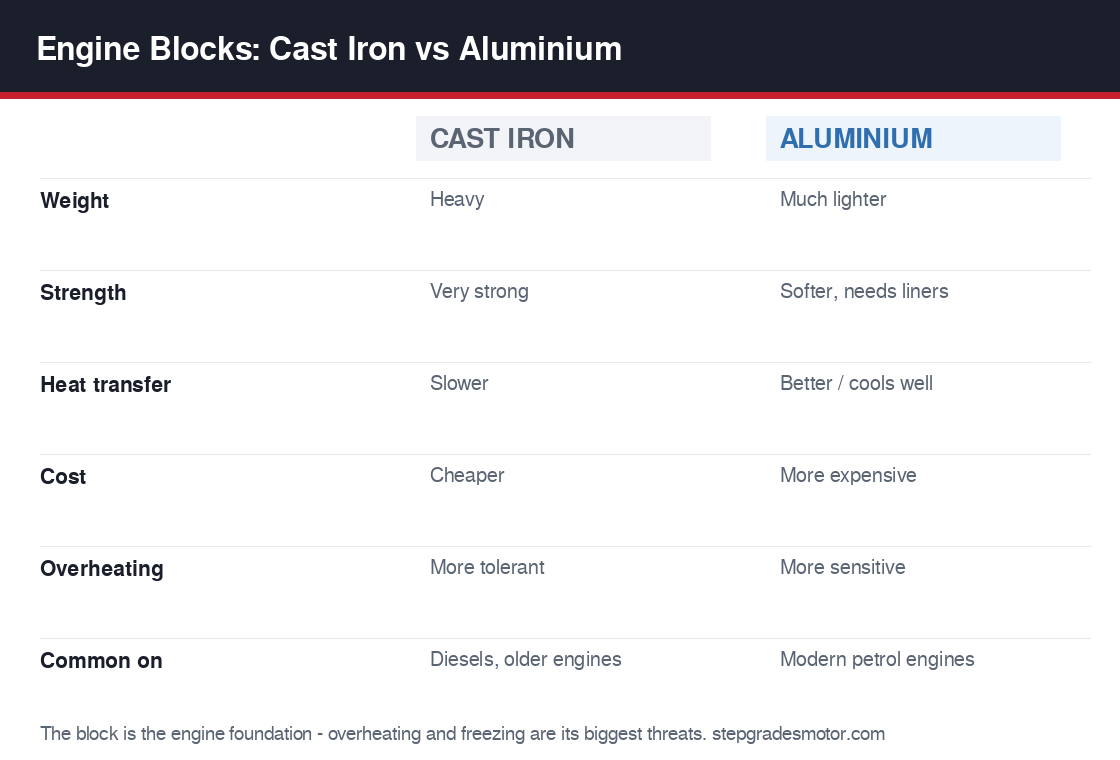
Cast iron blocks have been used for over a century because the material is strong, hard-wearing and relatively cheap, and it handles high combustion pressures well. Cast iron is especially common on diesel engines, where the compression forces are far higher. The downside is weight — cast iron is heavy.
Aluminium alloy blocks are much lighter and shed heat to the coolant more effectively, which improves efficiency and economy. That’s why most modern petrol engines use aluminium. The trade-off is that aluminium is softer than iron, so the cylinder bores must be protected with iron liners (wet or dry) or a special wear-resistant coating, and aluminium blocks are more sensitive to overheating. The video below shows how a cylinder block is constructed and works.
Types of engine block
Engine blocks are classified in a few different ways, which you’ll see referenced in specifications.
By cylinder layout
The block’s shape follows the engine’s configuration — en línea (cylinders in a row), V (two banks at an angle) or flat/boxer (horizontally opposed). This is the same classification we cover in our guide to the types of car engine.
By deck design: open vs closed
A closed-deck block has a solid top around the cylinders, giving great strength for high-performance and turbocharged engines. An open-deck block leaves coolant passages open at the top, which is cheaper to cast and lighter but less rigid.
By cylinder liners
Aluminium blocks in particular use wet liners (in direct contact with coolant) or dry liners (pressed into the bore), or a sprayed bore coating. These affect how the block can be repaired or rebored.
How engine blocks are made
Understanding how engine blocks are produced helps explain both their strength and their occasional weaknesses. The vast majority are made by casting — molten iron or aluminium is poured into a mould shaped like the block, complete with cores that form the hollow water jackets and oil galleries inside. Once the metal cools and solidifies, the rough casting is removed and then machined to its final, precise dimensions: the cylinder bores are honed, the deck surface is ground flat, and the bearing housings are line-bored.
This combination of casting and precision machining is why a block is simultaneously massively strong and accurate to fractions of a millimetre. It also explains rare casting defects like porosity — tiny voids left as the metal solidifies — which can occasionally cause leaks later in life. High-performance and some modern blocks use more advanced techniques, but the basic principle of cast-then-machine has remained the same for generations, and it’s why a damaged block generally can’t be “bent back” into shape the way simpler parts sometimes can.
Engine block vs cylinder head: what’s the difference?
People often confuse the engine block with the cylinder head, so it’s worth being clear. The block is the lower, larger casting that contains the cylinders and crankshaft. The cylinder head bolts to the top of the block and seals the cylinders, housing the valves and usually the camshaft. Between them sits the head gasket, which seals the join.
Together, the block and head form the core of the engine, but they do different jobs and fail in different ways. A warped or cracked head can sometimes be skimmed or replaced on its own relatively affordably. A cracked block, as we’ve seen, is far more serious because it’s the foundation everything else depends on. When diagnosing an overheating or coolant-loss problem, a good technician works out whether the fault lies in the head, the head gasket or the block itself — because the cost and the right solution are very different for each.
How long does an engine block last?
An engine block has no fixed lifespan — unlike wear items such as belts or bearings, it isn’t designed to be replaced on a schedule. In normal use, a well-maintained block will comfortably outlast the rest of the engine and often the car itself, lasting for hundreds of thousands of miles. The block is usually the most durable part of the whole engine.
What shortens a block’s life is almost never gentle age — it’s abuse or neglect, above all overheating and freezing. An engine run low on coolant, or filled with water instead of proper antifreeze, can destroy an otherwise healthy block in minutes. This is reassuring news for anyone buying a used engine: a block from a well-cared-for, low-mileage donor is very likely to be sound, which is exactly why reputable suppliers inspect and test the block before selling an engine.
Common engine block failures
Engine blocks are built to last the life of the engine, but they can and do fail — usually catastrophically when they do. The main failures are:
Cracked block
A crack in the block — often caused by overheating or freezing — is one of the most serious engine failures. Cracks can appear in the cylinder walls, the water jackets or around the main bearings, letting coolant and oil mix or escape.
Warped or damaged deck
Severe overheating can warp the block’s deck surface, preventing the head gasket from sealing and leading to repeated gasket failures.
Porosity and casting defects
Occasionally a block has tiny voids from the casting process (porosity) that only reveal themselves as leaks later in life.
Freeze (frost) damage
If coolant lacks antifreeze and freezes, the expanding ice can crack the block or push out the core plugs — a common cause of block failure in cold European winters.
Worn cylinder bores
Over very high mileage, the cylinder bores can wear oval or scored, reducing compression and causing oil consumption. This can sometimes be fixed by reboring, but severe wear may condemn the block.
Symptoms of a cracked or failing engine block
Block problems often show up as symptoms you might first blame on other parts. Watch for:
- Persistent overheating that doesn’t resolve with normal cooling-system fixes.
- Coolant loss with no visible external leak (it may be leaking internally).
- Oil and coolant mixing — a milky residue on the oil cap or dipstick, or oil in the coolant.
- White exhaust smoke and a sweet smell, indicating coolant burning in the cylinders.
- Visible cracks or external coolant/oil leaks on the block itself.
- Low compression in one or more cylinders, revealed by a compression test.
Several of these overlap with a blown head gasket, so proper diagnosis is essential to tell a gasket problem (often repairable) from a cracked block (usually terminal). A compression or leak-down test and a careful inspection are the way to be sure.
What causes engine block damage?
Most block failures trace back to a handful of causes, nearly all of them preventable:
- Overheating — the number-one killer of engine blocks, caused by cooling-system failures, low coolant or a stuck thermostat.
- Freezing — coolant without adequate antifreeze expanding in cold weather.
- Poor maintenance — neglected coolant and oil changes accelerating wear and corrosion.
- Manufacturing defects — rare casting flaws or porosity.
- Extreme stress — over-revving, detonation or heavy tuning beyond the block’s design limits.
The lesson is clear: look after the cooling system and use the correct coolant with antifreeze, and engine blocks will usually last the life of the car. Most block failures are the result of heat or neglect rather than simple age.
Can a cracked engine block be repaired?
Sometimes, but it depends on the location and severity. Specialist processes exist to repair cracked engine blocks — cold-metal stitching, welding (for cast iron or aluminium, by experts), or sealing minor cracks. These can work for certain cracks in accessible areas, and may be worthwhile for rare or valuable engines.
However, for most everyday cars, repairing a cracked block is often not cost-effective or reliable. The repair can be expensive and labour-intensive, with no guarantee of long-term success, especially for cracks in critical areas like the cylinders or main bearing housings. In the majority of cases, a cracked block means the engine has reached the end of its economical life — and fitting a sound replacement engine is the smarter, more reliable choice.
Engine block replacement vs full engine replacement
When a block is damaged, you technically have two options: replace just the bare block (and rebuild the engine around it) or replace the whole engine. In practice, for the vast majority of drivers, replacing the complete engine is the better route.
Replacing only the block means stripping your old engine completely, transferring all the internal parts to a new block, and rebuilding it — a huge, labour-intensive job that only makes sense if the rest of your engine’s internals are known to be in excellent condition. By contrast, fitting a complete, tested used or reconditioned engine is usually faster, more reliable and often cheaper overall, because you get a whole proven unit rather than a rebuild around an unknown core. For most cars with a failed block, a quality replacement engine is the practical answer.
There’s also the question of time off the road. A bare-block rebuild can tie your car up in a workshop for days or weeks while parts are transferred and machined, whereas a complete tested engine arrives ready to fit. For a vehicle you rely on, that difference in downtime often matters as much as the price — another reason most drivers choose a full replacement engine over a block-only repair.
How to check an engine block’s condition
Whether you’re assessing your own engine or inspecting a used unit before buying, a few checks tell you most of what you need to know about the block itself. Start with a careful visual inspection: look over the outside of the block for cracks, welds or signs of previous repair, paying attention to the areas around the core plugs, the cylinder walls and the main bearing area. Rust streaks or crusted coolant can hint at a leak.
Next, check the oil and coolant for signs they’ve mixed — a milky residue points to an internal breach that may involve the block or head gasket. A compression or leak-down test is the most revealing check of all, because it measures how well each cylinder seals and can expose bore wear, cracks or a failed gasket that the eye can’t see. Finally, where possible, confirm there’s no history of serious overheating, since that’s the single biggest threat to a block. These same principles sit at the heart of inspecting any used engine, which we cover in full in our guide on checking a second hand engine.
Buying a replacement engine with a sound block
If a failed block means you need a replacement engine, the condition of the new unit’s block is exactly what you should focus on. When choosing a used or reconditioned engine:
- Insist the block has been inspected for cracks, warping and bore wear.
- Ask for compression or leak-down test results, which reveal how well the bores, rings and valves are sealing.
- Match the engine code exactly to your vehicle.
- Buy a low-mileage unit from a sound donor, with a warranty.
A tested engine built on a solid block is the foundation of years of reliable motoring. To go further, read our guides on Cómo revisar un motor de segunda mano y Cómo comprar un motor de segunda mano en Europa, o echa un vistazo a nuestra selección de productos inspeccionados motores de coches de segunda mano. If you’re not sure which engine your car needs, Envíanos tu inscripción and we’ll confirm it.
Preguntas frecuentes
What is an engine block?
What are engine blocks made of?
What are the symptoms of a cracked engine block?
What causes an engine block to crack?
Can a cracked engine block be repaired, or should I replace the engine?
En resumen
The engine block is the foundation of the entire engine — the casting that houses the cylinders, supports the crankshaft and keeps every moving part in precise alignment. Whether cast iron or aluminium, a sound block is the heart of a healthy engine, and serious block damage such as a crack, warp or freeze failure usually spells the end of that engine’s economical life. The good news is that most block failures are preventable: look after the cooling system, use the right coolant with antifreeze, and keep up with maintenance.
When a block does fail, fitting a complete, tested replacement engine built on a solid block is almost always the better choice than an expensive, uncertain repair. Browse our inspected motores de coches de segunda mano, read our guides on piezas para motores de coche y cómo funciona el motor de un coche, o ponte en contacto con nuestro equipo with your registration and we’ll help you find the right engine for your vehicle.
 English
 Deutsch
 Français
 Italiano
 Español
 Nederlands
 Polski