
Blog
How to Buy a Used Engine in Europe: The Complete Buyer’s Guide

Replacing a failed engine is one of the biggest decisions a driver can face, and for most people a good motor de segunda mano is the smartest way to get back on the road without paying main-dealer prices. A carefully sourced, low-mileage unit can give you years of reliable service for a fraction of the cost of a brand-new engine — provided you know what to look for. This complete buyer’s guide walks you through everything you need to know to buy a used engine with confidence anywhere in Europe, from understanding the different types of replacement engine to inspecting a unit, matching it to your car, and arranging delivery and fitting.
En Motor Stepgrades we supply imported, inspected used engines to drivers, independent garages and fleet operators across the UK and mainland Europe, so this guide draws on exactly the questions buyers ask us every day. Whether you drive a Volkswagen in Germany, a Vauxhall/Opel in the UK, a Renault in France or a Fiat in Italy, the principles are the same — and by the end you’ll know how to avoid the common traps and get genuine value.
Signs your engine needs replacing
Before you start shopping, it’s worth being sure that a full engine replacement is actually necessary — sometimes a repair is enough. That said, certain symptoms strongly suggest the engine is at the end of its economic life and that a replacement used engine is the sensible route:
- Persistent knocking or rattling from deep inside the engine, especially under load, which can indicate worn bearings.
- Blue or white smoke from the exhaust, pointing to burning oil or coolant entering the cylinders.
- Milky oil or coolant loss with no external leak — classic head-gasket or cracked-block symptoms.
- Loss of compression or power that a service and simple repairs don’t fix.
- A repair quote that approaches the value of the car, at which point a replacement engine is far better value.
If a trusted mechanic confirms the engine is beyond economical repair, fitting a quality used engine is almost always cheaper than scrapping the car and buying another vehicle — and it lets you keep a car you already know and trust.
Why buy a used engine instead of a new one?
The single biggest reason drivers choose a used engine is cost. A brand-new engine from a manufacturer, once you add fitting, can easily exceed the value of an older car — which is why insurers frequently write vehicles off rather than repair them. A quality second-hand engine changes that maths completely, often costing 60–80% less than a new unit while still offering dependable performance.
There are three further advantages worth understanding:
- Availability. For many older and discontinued models, manufacturers no longer produce new engines at all. A used engine sourced from a breaker or importer is frequently the only realistic way to keep the car on the road.
- Proven, complete assemblies. Unlike a bare rebuild, a used engine is a complete, working unit that has already run for tens of thousands of miles. A low-mileage import typically has plenty of service life left and fits first time, which keeps labour costs down.
- Sustainability. Reusing a serviceable engine keeps a large, resource-intensive component out of the scrap stream. For environmentally conscious buyers across Europe, choosing used is a genuinely greener option than manufacturing new.
Of course, a used engine is only a bargain if it is sound. That is where the rest of this guide comes in.
Used, reconditioned, rebuilt or new: what’s the difference?
Before you start shopping, it helps to understand the four broad categories of replacement engine you’ll encounter. Prices rise as you move down the list, but so does the amount of new work involved.
Used (second-hand) engines
A used engine is a complete unit removed from a donor vehicle, typically one that has been dismantled after an accident or at the end of its life. A reputable supplier will clean, inspect and compression-test the engine before selling it. Low-mileage imported engines fall into this category and offer the best balance of price and reliability.
Reconditioned engines
A reconditioned engine has been partially or fully stripped, with worn parts (bearings, seals, gaskets, sometimes pistons or the cylinder head) replaced to bring it back toward factory tolerances. Reconditioning costs more than a straight used engine but less than new, and the term is not tightly regulated — always ask exactly what work was done.
Rebuilt / remanufactured engines
A remanufactured engine is stripped completely and rebuilt to a defined specification, usually with a longer warranty. This is the most expensive used-engine option and is popular for high-value or hard-to-replace vehicles.
New engines
A brand-new engine from the manufacturer is the most expensive route and rarely cost-effective for a vehicle more than a few years old.
| Option | Typical cost | Service life left | Best for |
|---|---|---|---|
| Used / second-hand | € | High (low-mileage import) | Most drivers & older cars |
| Reconditioned | €€ | High | Buyers wanting renewed wear parts |
| Remanufactured | €€€ | Very high | High-value / rare vehicles |
| New (OEM) | €€€€ | Maximum | Nearly-new or specialist cases |
How much does a used engine cost in Europe?
There is no single answer, because the price of a used engine depends on the make, the engine size, its rarity, mileage and condition. As a rough guide, a common four-cylinder petrol engine for a mainstream European hatchback might cost a few hundred euros, while a large performance V6 or V8, a diesel unit, or an in-demand imported engine can run into the low thousands.
The main factors that move the price are:
- Engine size and cylinders. Larger engines with more cylinders cost more.
- Petrol vs diesel. Diesel engines are often pricier due to more complex components.
- Mileage and condition. A genuinely low-mileage, inspected import commands a premium — and is usually worth it.
- Rarity and demand. Popular tuning and performance engines hold their value strongly.
- Delivery. A used engine is heavy, so factor in pallet or freight delivery to your country.
When comparing prices, always compare like for like: a cheap, untested engine from an anonymous seller is no bargain if it fails within weeks. Browse our current motores de coches de segunda mano to see realistic, inspected pricing, and remember that our prices already include our quality checks.
Where to buy a used engine in Europe
You have several options, each with pros and cons. Understanding them helps you choose a seller you can trust.
Scrapyards and vehicle dismantlers (breakers)
Local breakers can be cheap, but the engine is often sold “as removed” with no testing, no warranty and no guarantee it will fit your exact variant. You may also need to remove it yourself. This route suits experienced mechanics who can assess an engine on sight.
Specialist importers and used-engine suppliers
Specialists like Motor Stepgrades source low-mileage engines from carefully dismantled donor vehicles, inspect and compression-test them, and dispatch them on tracked pallet couriers with a guarantee. You pay a little more than a bare scrapyard price, but you get a tested unit, fitment support and after-sales cover — which almost always works out cheaper in the long run.
Online marketplaces
General marketplaces list thousands of engines, but quality and seller reliability vary enormously. If you buy this way, insist on clear photos, the engine code, mileage, and a returns policy, and be wary of prices that look too good to be true.
What to look for in a used-engine seller
- Do they state the engine code and mileage for each unit?
- Do they inspect and test engines before sale?
- Is there a clear warranty and returns policy?
- Will they confirm fitment for your registration before you buy?
- Do they offer tracked delivery across Europe with proper packaging?
If a seller can’t answer those questions, walk away. A trustworthy supplier will happily confirm everything in writing.
How to check a used engine before you buy
This is the most important part of the process. Whether you’re inspecting an engine in person or buying online from a specialist, these are the checks that separate a great used engine from an expensive mistake. The video below from a respected automotive channel is a helpful visual walk-through of what to look for.
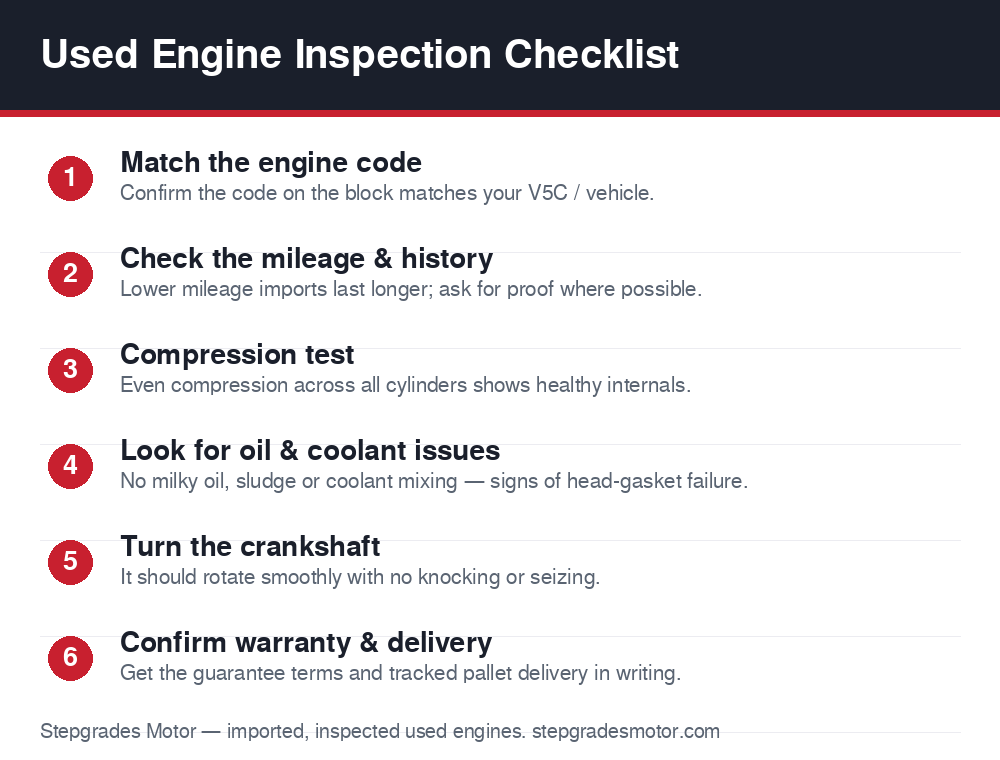
1. Match the engine code
The single most important check is that the engine code stamped on the block matches the engine your car needs. Engines that look similar can differ in mounting points, wiring, sensors and emissions equipment. You’ll usually find the code on the block itself and referenced on your vehicle documents. In the UK you can cross-check details on your V5C registration certificate; other European countries have equivalent registration papers.
2. Check the mileage and history
Lower mileage generally means more service life left. Ask how the mileage was verified and whether any service history came with the donor vehicle. A reputable importer will be transparent about what is known and what isn’t.
3. Ask for (or perform) a compression test
Even compression across all cylinders is one of the best indicators of healthy internals. Big variations between cylinders can point to worn rings, valves or a head-gasket problem. Good suppliers compression-test engines as standard — ask to see the results.
4. Look for oil and coolant warning signs
Milky or “mayonnaise” oil, sludge, or coolant mixing with oil are classic signs of head-gasket failure. Check the oil filler cap and dipstick if you can, and ask the seller directly what they found during inspection.
5. Turn the crankshaft
The engine should rotate smoothly by hand (or on the starter) with no knocking, grinding or seizing. Any harsh noise is a red flag.
6. Confirm the warranty and delivery terms
Before money changes hands, get the guarantee period, what it covers, and the delivery arrangements in writing. A heavy used engine needs proper pallet packaging and tracked freight — flimsy packing leads to transit damage.
Matching the right engine to your car
Getting the wrong engine is the most expensive mistake a buyer can make, and it’s almost always avoidable. The golden rule is: match by engine code, not just make and model. Two cars of the same model year can use different engines depending on trim, market and emissions standard.
When you contact a supplier, have these details ready:
- Your vehicle registration and, where possible, the VIN.
- The engine code (from the block or your registration document).
- The car’s year, trim and fuel type.
Buyers in mainland Europe should also consider left-hand-drive versus right-hand-drive ancillaries and any market-specific emissions equipment. A good specialist will confirm all of this for you before you order — at Stepgrades Motor we verify fitment against your registration as standard, so you never gamble on compatibility. If you also need a matching gearbox or transmission, buying a matched pair from one supplier saves time and avoids compatibility headaches.
Petrol vs diesel used engines
Both petrol and diesel used engines are widely available across Europe, and the right choice depends on your car and how you use it.
Petrol engines are generally simpler, cheaper to buy and repair, and well suited to lower-mileage urban driving. Diesel engines cost more but offer strong torque and fuel economy for higher-mileage motorway drivers, which is why they remain popular across Germany, France and much of mainland Europe. Diesel units have more complex components — turbochargers, injectors, DPFs and EGR systems — so inspection is even more important. Whichever you choose, the checks above apply equally.
What about imported (JDM) used engines?
Many of the best-value used engines in Europe are imports, particularly Japanese Domestic Market (JDM) units. Japan’s strict vehicle inspection regime (the “shaken”) means cars are frequently retired with relatively low mileage, so their engines often have far more life left than a comparable European unit at the same age. That’s why imported engines have become a mainstay for enthusiasts and everyday drivers alike.
Popular examples include Honda’s K-series, Nissan’s VQ-series V6s and Toyota’s legendary inline engines — all in strong demand for both repairs and performance builds. When buying an import, the same rules apply: confirm the engine code, check the mileage, insist on inspection, and buy from a supplier who tests units and confirms fitment. Browse our full range of imported motores de coches de segunda mano y motores de camión to see what’s available.
Warranty, delivery and fitting across Europe
A used engine is heavy and valuable, so how it’s covered and shipped matters as much as the engine itself.
Warranty. Look for a clear, written guarantee. Understand what it covers (typically internal mechanical failure), the period, and what you need to do to keep it valid — for example, fitting by a competent mechanic and using the correct oil.
Delivery. Across the UK and mainland Europe, engines should travel on securely strapped pallets with tracked freight. Check delivery times and costs to your country before you order. At Stepgrades Motor we ship UK-wide and across Europe with full tracking.
Fitting. Unless you’re an experienced mechanic, have the engine fitted by a professional garage. It’s the ideal time to renew service items — timing belt or chain, water pump, and gaskets — which protects your investment and is often required to keep the warranty valid.
Used engines, emissions and roadworthiness in Europe
One question we hear from buyers across Europe is whether fitting a used engine affects roadworthiness testing. In most countries the answer is straightforward: as long as the replacement engine is the correct type for your vehicle and its emissions equipment is intact and functioning, a used engine will pass the national inspection just like the original.
The key is that the periodic technical inspection — the MOT in the UK, the TÜV in Germany, the Contrôle Technique in France, the ITV in Spain, the Revisione in Italy and the APK in the Netherlands — checks that the car meets the emissions standard it was originally type-approved to. That’s another reason to match your used engine by engine code: fitting the correct unit keeps the catalytic converter, sensors and emissions systems compatible, so the car continues to meet its original standard.
Two practical tips:
- Keep the paperwork for the used engine (engine code, invoice and warranty) with your vehicle records in case an inspector or insurer asks.
- If you’re importing a used engine into another EU country, check whether any local documentation is required — a reputable supplier can advise.
Buying and fitting the correct engine keeps you legal and on the road; if you’re ever unsure which unit your car needs, ask our team before you order.
Used engines for vans and light commercials
It isn’t only cars that benefit from a good used engine. Vans, pickups and light commercials cover high mileages and are expensive to take off the road, so a tested replacement engine keeps a working vehicle earning instead of sitting in a workshop. The same buying rules apply — match by engine code, insist on inspection, and choose palletised delivery. For heavier vehicles and HGVs, see our dedicated range of motores de camión de segunda mano.
Common mistakes to avoid when buying a used engine
- Buying on price alone. The cheapest engine from an untested source is rarely the cheapest once you add re-work or a second purchase.
- Skipping the engine-code check. “It’s the same car” is not enough — always verify the code.
- Ignoring delivery packaging. A poorly packed engine can arrive damaged; insist on proper pallet freight.
- Not reading the warranty. Know exactly what’s covered before you pay.
- Forgetting the ancillaries. Confirm what’s included (manifolds, sensors, wiring) and what you’ll need to transfer from your old engine.
Your used engine buyer’s checklist
Before you commit, run through this quick recap:
- ✅ Engine code confirmed against your vehicle
- ✅ Mileage and history understood
- ✅ Compression / inspection results seen
- ✅ No oil or coolant warning signs
- ✅ Warranty terms in writing
- ✅ Tracked, palletised delivery to your country
- ✅ Fitting and service items planned
Tick every box and you can buy your used engine with genuine confidence.
Frequently asked questions
How long does a used engine last?
Is it safe to buy a used engine online?
¿Cómo puedo saber si un motor de segunda mano es compatible con mi coche?
How much can I save with a used engine?
Do you deliver used engines across Europe?
Buy your used engine with confidence
A used engine is one of the smartest purchases a driver can make — but only when you buy the right unit from the right supplier. Match by engine code, insist on inspection and a written warranty, and choose a specialist who confirms fitment and delivers properly across Europe. Do that, and you’ll enjoy dependable, OEM-quality performance at a fraction of the cost of new.
Ready to find the right engine for your vehicle? Browse our inspected motores de coches de segunda mano, o contact our team with your registration and engine code and we’ll confirm the perfect match for your car — wherever you are in Europe.
 English
  Deutsch
  Français
  Italiano
  Español
  Nederlands
  Polski