
Blog
Vauxhall/Opel Corsa Engine Replacement: Costs & Options

The Vauxhall Corsa — sold as the Opel Corsa across mainland Europe — is one of the best-selling cars the continent has ever seen. With so many on the road, engine problems are inevitable as they age, and sooner or later many owners face the question: repair, or replace the engine? This guide explains everything you need to know about Corsa engine replacement — the common engines, the warning signs, your options, the likely costs, and how to choose the right replacement — for drivers across the UK and Europe.
At Stepgrades Motor we supply imported, inspected engines to drivers and garages across Europe, and the Corsa is one of the models we’re asked about most, simply because there are so many of them. By the end of this article you’ll understand your Corsa engine replacement options and how to get the best value, whether you drive a Vauxhall in Britain or an Opel in Germany, France or Spain.
The Vauxhall/Opel Corsa: a European favourite
Since its launch in 1982, the Corsa has been a staple of European roads — a compact, affordable and practical supermini that’s been a top seller in the UK, Germany, Spain, Italy and beyond for decades. Through its generations (the Corsa B, C, D, E and the latest F), it’s been a popular first car, city runabout and family second car, which means millions are still in daily use.
That popularity is exactly why Corsa engine replacement is such a common need. As these cars pass 100,000 miles and beyond, engines wear, and because the Corsa is an affordable car, owners naturally look for cost-effective ways to keep a sound, familiar vehicle on the road rather than scrapping it. A replacement engine is very often the smart, economical answer.
Common Corsa engines
Over the years the Corsa has used a wide range of engines, and knowing which one your car has is the essential first step. The most common include:
- 1.0, 1.2 and 1.4 petrol — the bread-and-butter small petrol engines found across most Corsa generations, including the Twinport and later units.
- 1.2 and 1.4 Turbo petrol — the more modern, downsized turbocharged petrol engines in the Corsa E and F.
- 1.0 three-cylinder turbo — fitted to newer models for efficiency.
- 1.3 CDTi diesel — the popular small diesel, common in the Corsa C, D and E.
- 1.5 diesel and 1.7 CDTi — other diesel options across the range.
Each of these comes in specific variants with their own engine codes, and a replacement must match your exact engine code — not just the engine size. We’ll return to why that matters below.
Signs your Corsa engine needs replacing
Before assuming the worst, it’s important to recognise the signs of genuine engine failure, as opposed to a cheaper fault. Symptoms that may point to a serious Corsa engine problem include:
- Knocking or rattling noises from the engine, especially a timing-chain rattle on some petrol units.
- Heavy blue smoke and high oil consumption — a known issue on some older 1.2 Corsa engines.
- Loss of compression or a misfire that won’t clear, sometimes from a cracked piston or worn bores.
- Overheating that damages the head gasket or block.
- A snapped camshaft or timing failure, which can cause major internal damage.
- A complete no-start with evidence of internal failure.
Crucially, several Corsa “engine” symptoms are actually caused by much cheaper parts — a crankshaft sensor, ignition coil packs, spark plugs or a PCV valve can all mimic serious engine trouble. The video below shows how to diagnose Corsa misfires with basic tools before spending big.
Corsa engine replacement by generation
Because the Corsa has run through so many generations, the replacement engine you need depends heavily on your model year:
- Corsa C (2000–2006): mostly 1.0, 1.2 and 1.4 petrol Twinport engines, plus the 1.3 CDTi diesel. Simple, plentiful engines that are cheap to source second-hand.
- Corsa D (2006–2014): 1.0, 1.2 and 1.4 petrol and the popular 1.3 CDTi diesel. One of the most common Corsas on the road, so used engines are widely available.
- Corsa E (2014–2019): introduced newer 1.0 and 1.4 turbo petrol units alongside the familiar 1.2 and 1.4, and the 1.3 CDTi diesel.
- Corsa F (2019 onward): the current, Peugeot-platform Corsa, with 1.2 PureTech petrol (including turbo) and 1.5 diesel engines shared with the wider Stellantis group.
Identifying your generation and exact engine code is the foundation of a successful replacement. Fitting the right engine for your specific Corsa generation avoids costly compatibility problems with mounts, wiring and electronics.
Corsa engine replacement options
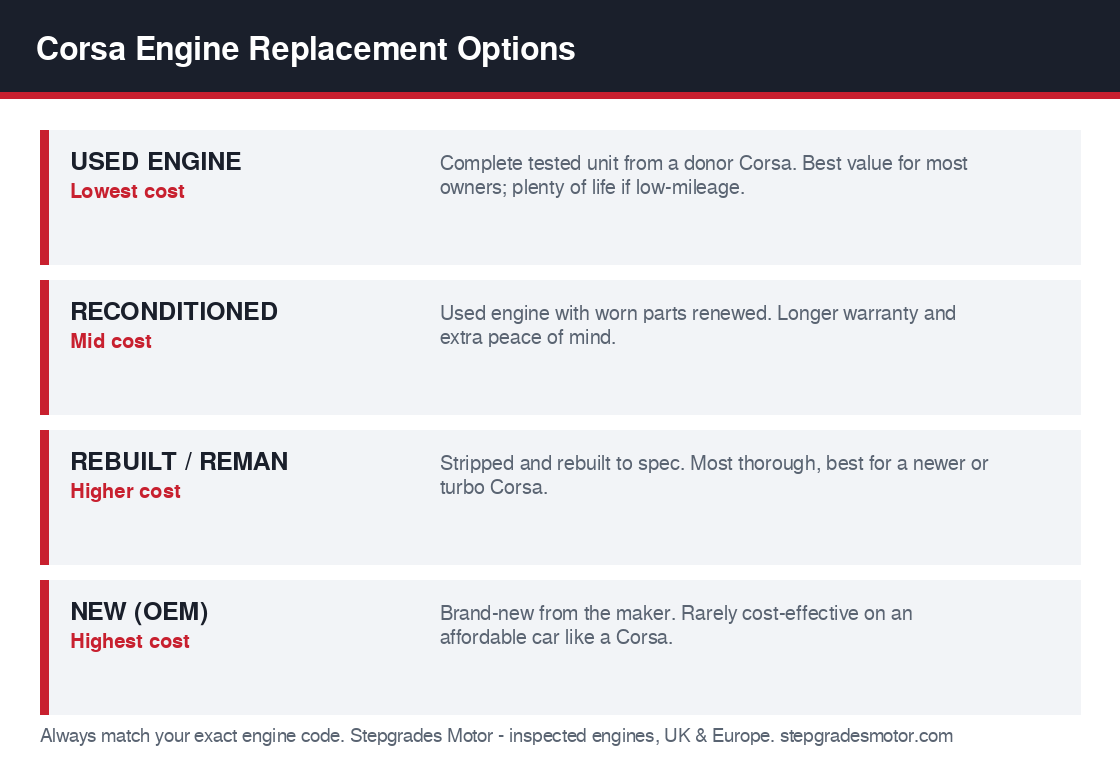
If diagnosis confirms you do need a new engine, you have four main routes, each with different costs and trade-offs:
- Used (second-hand) engine — a complete, tested engine from a donor Corsa. Usually the most cost-effective option, offering plenty of service life if it’s a low-mileage import.
- Reconditioned engine — a used engine with worn parts renewed, typically carrying a longer warranty.
- Rebuilt/remanufactured engine — stripped and rebuilt to specification, the most thorough but priciest option.
- New (OEM) engine — rarely cost-effective for an affordable car like a Corsa.
For the vast majority of Corsa owners, a quality used or reconditioned engine delivers the best balance of cost and reliability. A full comparison is in our guide on reconditioned versus used versus rebuilt engines.
How much does a Corsa engine replacement cost?
There’s no single figure, because the cost depends on which engine your Corsa has, the route you choose, and fitting. As a general pattern across Europe, a used Corsa engine is the most affordable to buy, a reconditioned one costs more but adds peace of mind, and a rebuilt or new engine is dearest. To any of these you must add fitting labour, which varies by garage and location.
The good news is that because the Corsa is so common, its engines are widely available and competitively priced — you’re not chasing a rare unit. When comparing quotes, always factor in the total cost: the engine itself, delivery, what’s included (bare unit or with ancillaries), the warranty, and fitting. A cheap engine with no warranty and expensive shipping can cost more overall than a dearer, tested unit that arrives ready to fit. Because a Corsa is an affordable car, keeping the total replacement cost sensible is key to making it worthwhile — which is usually very achievable with a good used engine.
Which replacement is right for your Corsa?
The best choice depends on your car and plans:
- Older, higher-mileage Corsa you want to keep running affordably: a quality low-mileage used engine is usually the smartest spend.
- A Corsa you plan to keep for several more years: a reconditioned engine, with its longer warranty, can be worth the extra.
- A valuable or newer Corsa (e.g. a turbo model): a reconditioned or rebuilt unit may make more sense to protect the investment.
For most everyday Corsas, the economics strongly favour a tested used engine. The car simply isn’t valuable enough to justify an expensive rebuild when a sound used unit will give years of reliable service for far less.
How to choose a used Corsa engine
Choosing well is what makes a Corsa engine replacement a success rather than a gamble. Keep these essentials in mind:
- Match the engine code exactly. The Corsa used many engine variants; the replacement must be the correct code for your specific car, year and specification — not just “a 1.2”. You’ll find the code on the engine and your vehicle papers.
- Choose a low-mileage, tested unit. Ask for compression or testing evidence.
- Confirm what’s included. Is it a bare engine, or does it include manifolds, injectors and ancillaries? Some suppliers provide a stripped unit, so you may need to transfer parts.
- Buy from a reputable supplier who confirms fitment and offers a warranty.
For the full process, read our guides on how to buy a used engine in Europe and how to check a second hand engine, or browse our range of inspected used car engines.
Common Corsa engine problems to know
Understanding the Corsa’s known weak points helps you diagnose faults and choose a sound replacement. Common issues across the range include timing-chain and tensioner wear on some petrol engines (causing rattling and misfires), oil consumption on older 1.2 units, weak cam belts on the smallest petrols, and, on certain turbo engines, piston problems. Camshaft and tensioner failures can cause serious internal damage if ignored.
The takeaway is twofold: first, keep up with timing-chain or belt servicing and oil changes to avoid these failures; and second, when buying a used Corsa engine, check specifically for the known weak points of that engine variant. A low-mileage, well-maintained unit that’s been inspected is far less likely to carry these problems forward.
Petrol or diesel Corsa engine: what to replace with
Whichever engine your Corsa has, a like-for-like replacement is the rule — you replace a petrol with the same petrol and a diesel with the same diesel, matched by engine code. But the type does affect what to look for. On a petrol Corsa engine (the most common), pay attention to timing-chain or cam-belt condition and any history of oil consumption on the older 1.2 units. On a diesel Corsa engine like the 1.3 CDTi, the turbo, injectors and particulate filter matter most, especially if the car was used mainly for short trips.
Diesel Corsas tend to suit higher-mileage drivers, while the petrols suit lower-mileage town use — a distinction we explore in our guide to petrol versus diesel engines. When sourcing a replacement, make sure the unit matches not just the size but the exact fuel and specification of your original, as even same-size petrol and diesel units are completely different engines.
How long should a Corsa engine last?
A well-maintained Corsa engine can comfortably cover 120,000–150,000 miles or more, and many go much further with good care. What shortens their life is usually neglect rather than age: skipped oil changes, ignoring a rattling timing chain, running low on oil, or overheating. The small petrol engines in particular reward regular servicing and prompt attention to warning signs.
This is reassuring when buying a used replacement: a Corsa engine from a well-cared-for, lower-mileage donor is very likely to have plenty of life left. It’s exactly why a compression test and a known service history add so much value, and why a low-mileage imported unit can be such a sound, long-lasting basis for your replacement.
Repair or replace your Corsa engine?
Not every Corsa engine problem means a full replacement. If the fault lies in a bolt-on part — a coil pack, crankshaft sensor, PCV valve, water pump or even a head gasket on an otherwise sound engine — a targeted repair is usually the cheaper, sensible route. This is why proper diagnosis matters so much before committing to a new engine.
However, when the problem is deep in the engine’s core — worn bores and low compression, a cracked piston, a snapped camshaft, or serious overheating damage — the cost of a proper internal rebuild often approaches or exceeds the value of the car. In those cases, fitting a complete, tested replacement engine is almost always the smarter, more economical choice for a Corsa, giving you a whole proven unit rather than an uncertain repair.
Fitting a replacement Corsa engine
Fitting a Corsa engine is a job for a competent garage, and most warranties require professional installation. Fitting is also the ideal time to renew service items that are cheaper to replace while the engine is out — the timing belt or chain, water pump, thermostat and relevant gaskets — which protects your new engine from day one.
Be clear with your fitter about what the replacement engine includes, so any ancillaries that need transferring from your old engine (such as the manifold, injectors or sensors) are accounted for. Using the correct oil and a new filter from the first start is usually a warranty condition too. Done properly, a quality used Corsa engine fitted by a good garage will give the same dependable service as a far more expensive option, at a fraction of the cost.
Buying a Corsa engine online across Europe
Most Corsa engine purchases now begin online, giving you far more choice than your local area. Because the Corsa is so common across the UK and Europe, sound used engines are widely available and competitively priced. Buy carefully: choose a seller who states the engine code and mileage, confirms fitment for your registration, provides testing evidence, offers a written warranty, and ships on secured, tracked pallet freight.
At Stepgrades Motor we deliver inspected engines across the UK and mainland Europe and confirm fitment for your exact vehicle before you order. If you’re unsure which Corsa engine your car needs, send us your registration and we’ll identify the correct unit for you.
Your Corsa engine buying checklist
Before you commit to any Corsa engine replacement, run through this quick recap to make sure you’re getting genuine value:
- ✅ You’ve diagnosed the fault properly and ruled out cheaper causes (sensors, coil packs, PCV valve).
- ✅ You know your exact engine code and Corsa generation.
- ✅ The replacement is matched to that code, fuel type and specification.
- ✅ It’s a low-mileage, tested unit with compression or inspection evidence.
- ✅ You know what’s included (bare engine or with ancillaries).
- ✅ There’s a clear written warranty and confirmed fitment for your registration.
- ✅ Tracked, palletised delivery to your location is arranged.
- ✅ You’ve budgeted for fitting and renewing service items while the engine is out.
Tick every box and your Corsa engine replacement should be a smooth, cost-effective success that keeps your car reliably on the road for years to come.
Frequently asked questions
How much does it cost to replace a Corsa engine?
Is it worth replacing the engine in a Vauxhall Corsa?
How do I know which engine my Corsa has?
What are the common engine problems on a Corsa?
Can I fit a bigger or different engine in my Corsa?
Making your replacement Corsa engine last
Once your new engine is fitted, a little care keeps it healthy for the long haul. Stick to the service schedule with the correct oil and filter, and don’t skip oil changes — clean oil is the cheapest protection your engine has. On petrol Corsas, keep an ear out for any timing-chain rattle and have it checked promptly, and on the older 1.2 units keep an eye on the oil level between services. On diesels, give the car a regular longer run to keep the particulate filter and turbo healthy.
It’s also worth addressing the small things at fitting time — a fresh timing belt or chain where applicable, water pump, thermostat and hoses — so your replacement engine starts life with sound ancillaries. Treat a good used Corsa engine with this basic care and there’s no reason it shouldn’t give you years of dependable, affordable motoring, exactly as the original did when the car was new. For most owners, that’s what makes a replacement engine such a sensible alternative to scrapping a car they know and trust.
The bottom line
With so many Vauxhall and Opel Corsas on Europe’s roads, engine replacement is a common and very manageable need. The keys are to diagnose the fault properly first (ruling out cheaper causes like sensors and coil packs), then choose the right replacement — for most Corsas, a quality low-mileage used engine offers the best balance of cost and reliability. Match the engine code exactly, buy a tested unit from a reputable supplier, and have it fitted properly, and your Corsa can give years more dependable service for a fraction of the cost of a new car.
Ready to find the right engine for your Corsa? Browse our inspected used car engines, read our guides on buying a used engine and checking a second hand engine, or contact our team with your registration and we’ll confirm exactly which Corsa engine your car needs.
 English
 Deutsch
 Français
 Italiano
 Español
 Nederlands
 Polski