
Blog
Petrol vs Diesel Engines: Pros, Cons and Running Costs

Few car-buying questions divide opinion like petrol versus diesel. For decades diesel was the default for anyone covering serious miles, while petrol ruled the city — but tightening emissions rules, low-emission zones and ever more efficient engines have blurred the lines. So which is right for you? This guide compares the petrol engine and the diesel engine head to head — how they work, their pros and cons, and above all the real running costs — so you can decide with confidence.
At Stepgrades Motor we supply imported, inspected petrol and diesel engines to drivers and garages across the UK and mainland Europe, so we see both sides of this debate every day. By the end of this article you’ll know exactly where each type wins, roughly where the cost break-even lies, and which suits your driving — whether you run a small petrol city car in Italy or a high-mileage diesel estate in Germany.
Petrol vs diesel: the fundamental difference
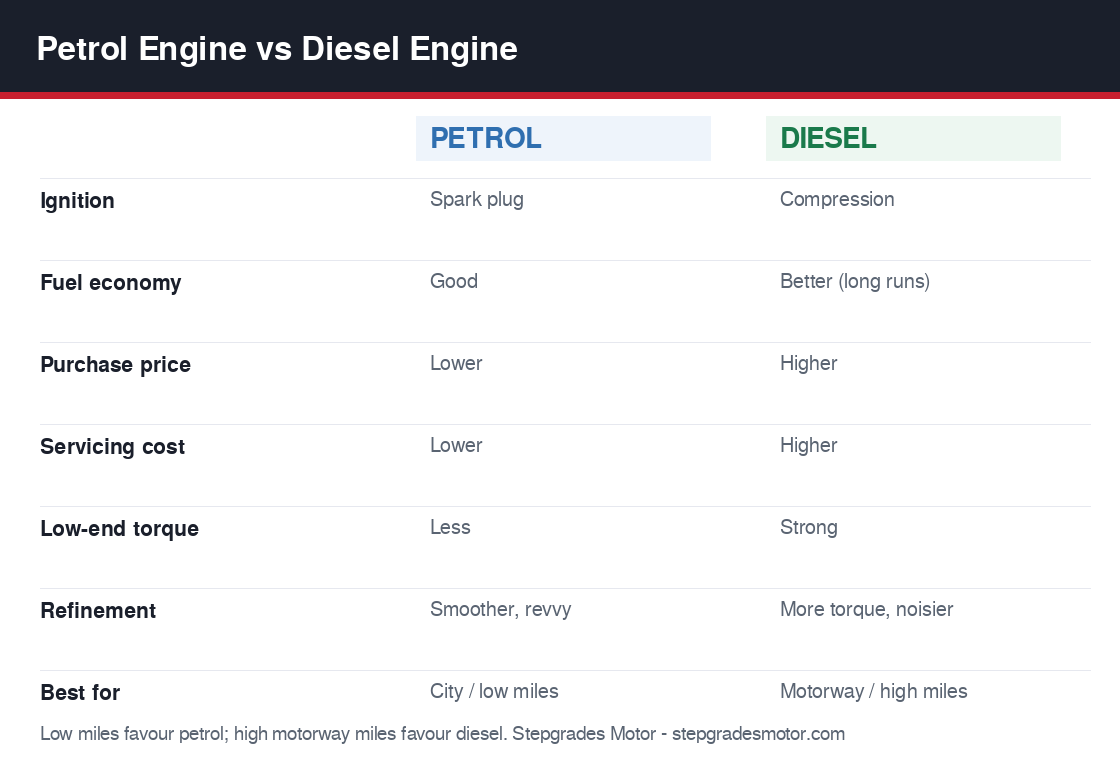
Both petrol and diesel engines are four-stroke internal combustion engines, and both turn fuel into motion in broadly the same way. The crucial difference is how they ignite their fuel. A petrol engine mixes fuel and air, compresses it, and ignites it with a spark from the spark plug — known as spark ignition. A diesel engine compresses only air, and compresses it much harder, until it’s hot enough to ignite the fuel the instant it’s injected — known as compression ignition, with no spark plug at all.
That single difference ripples through everything else. The diesel’s much higher compression makes it more thermally efficient and gives it strong low-down torque, but also makes it heavier, costlier to build and noisier. The petrol engine’s lighter construction lets it rev more freely and run more smoothly and quietly, at the expense of outright efficiency. Understanding this one distinction explains almost every pro and con that follows.
How a petrol engine works
A petrol engine draws a mixture of fuel and air into each cylinder, compresses it, and fires a spark plug to ignite it; the resulting expansion drives the piston down and turns the crankshaft. Because the mixture is ignited by a precisely timed spark, petrol engines can rev high and respond quickly, which is why they feel lively and refined. If you’d like the full step-by-step of the four-stroke cycle that both engine types share, see our guide on how a car engine works. For now, the key point is that the petrol engine’s spark-ignition design is what gives it its smooth, free-revving character.
The pros of a petrol engine
Petrol engines have a lot going for them, especially for everyday drivers:
- Cheaper to buy. A petrol car usually costs less upfront than the equivalent diesel model.
- Smoother and quieter. Petrol engines run more refined and rev more freely, which many drivers prefer.
- Lower servicing and repair costs. With fewer complex emissions components than modern diesels, a petrol engine is generally simpler and cheaper to maintain.
- Better suited to short, low-mileage trips. A petrol engine warms up quickly and doesn’t rely on long runs to stay healthy.
- Cheaper to repair after a fault. Fewer high-pressure and after-treatment parts means fewer expensive things to go wrong.
For city drivers, lower-mileage motorists and anyone who values a quiet, responsive drive, the petrol engine is often the smarter, simpler choice.
The cons of a petrol engine
No engine is perfect, and the petrol engine has its weaknesses too:
- Higher fuel consumption. A petrol engine typically uses more fuel than a diesel for the same journey, especially on the motorway.
- Less torque at low revs. Petrol engines make their best power higher up the range, so they’re less effortless when towing or carrying heavy loads.
- More CO2 per mile in many cases. Lower efficiency can mean higher fuel use and running cost over long distances.
These drawbacks matter most to high-mileage and heavy-duty drivers — which is exactly where the diesel engine steps in.
The pros and cons of a diesel engine
Diesel engines are the natural counterpart to petrol, and they shine in different conditions. On the plus side, a diesel delivers better fuel economy — often 20–30% more miles per gallon than an equivalent petrol, especially on long, steady motorway runs. It produces strong low-down torque, making it excellent for towing, carrying loads and effortless motorway cruising. Diesels are also built tough to handle their high compression, so they often enjoy a long service life when well maintained.
The trade-offs are real, though. A diesel usually costs more to buy, is noisier and heavier, and carries more complex and expensive components — turbochargers, high-pressure injectors, EGR valves and particulate filters — which can be costly to repair. Crucially, a diesel needs regular long runs to keep its particulate filter clear; used only for short city trips, it can suffer blockages and faults. The video below breaks down the petrol-versus-diesel comparison in detail.
Running costs compared: petrol vs diesel
For most buyers, running cost is the deciding factor, so let’s break it down across the areas that matter. The headline is simple: a petrol engine tends to be cheaper to buy and maintain, while a diesel is cheaper to fuel over long distances — and which wins overall depends on how much you drive.
The smart way to think about it is total cost of ownership rather than any single figure. Fuel is only one part of the picture; purchase price, servicing, tyres, tax, insurance, any city-zone charges and eventual resale value all add up over the years you own the car. A diesel’s fuel savings can be real, but they only pay off if they outweigh its higher upfront and maintenance costs over your ownership period. Weighing all these together, rather than fixating on miles per gallon alone, is how you work out which engine is genuinely cheaper for your situation.
Purchase price
A diesel model almost always costs more to buy than the equivalent petrol, both new and used, because the engine is more expensive to build. That price premium is money you need to earn back through fuel savings — which only happens if you cover enough miles.
Fuel economy and fuel price
This is the diesel’s trump card. A diesel engine’s higher efficiency means it uses noticeably less fuel, particularly on long motorway journeys at steady speed. Fuel prices vary across Europe and between petrol and diesel from country to country, but the efficiency advantage means a diesel generally costs less per mile to fuel — the more motorway miles you do, the bigger the saving.
Servicing and repairs
Here the petrol engine fights back. Modern diesels carry complex emissions and fuel-injection hardware that can be expensive to service and repair, and components like the particulate filter, EGR valve and turbo can be costly if they fail. A petrol engine is generally simpler and cheaper to keep on the road.
Road tax, emissions charges and low-emission zones
Taxation varies widely across European countries, but the trend is clear: many cities now operate low-emission or clean-air zones that can charge or restrict older diesels in particular. If you regularly drive into city centres across Europe, it’s worth checking local rules, as they increasingly favour petrol and electrified vehicles — this can tip the running-cost balance for urban drivers.
Insurance and depreciation
Insurance differences are usually modest and depend more on the specific car than the fuel type. Depreciation, however, has shifted: with tightening diesel rules in some markets, diesel resale values can be less predictable than they once were, while efficient petrols and hybrids hold up well for typical buyers.
How they feel to drive: performance and refinement
Numbers aside, petrol and diesel engines simply feel different from behind the wheel, and that matters for day-to-day enjoyment. A petrol engine likes to rev; it builds power smoothly towards higher engine speeds, delivers crisp throttle response and runs quietly, which makes it feel eager and refined in town and on twisty roads. For drivers who enjoy a lively, hushed car, the petrol engine is usually the more satisfying companion.
A diesel feels quite different. Its strength is torque — a strong, muscular surge from low revs that makes overtaking and motorway cruising effortless, and towing almost unbothered. You change gear less often and the engine feels relaxed at speed. The trade-offs are a little more noise and vibration, especially when cold, and less appetite for high revs. Modern diesels are far quieter and smoother than their predecessors, but the fundamental characters remain: petrol for free-revving refinement, diesel for effortless pulling power.
Which is cheaper to run? The mileage break-even
The honest answer to “petrol or diesel?” is: it depends on your annual mileage. Because a diesel costs more to buy but less to fuel, there’s a break-even point where its fuel savings start to outweigh its higher purchase and servicing costs.
As a broad rule of thumb across Europe, lower-mileage drivers — roughly those covering modest annual distances with lots of short, urban trips — tend to be better off with a petrol engine. Higher-mileage drivers who rack up long motorway journeys usually come out ahead with a diesel, because the fuel savings accumulate fast enough to repay the premium. The exact crossover depends on fuel prices, the specific models and how you drive, but the principle is reliable: low miles favour petrol, high miles favour diesel. If most of your driving is short hops around town, a petrol engine is very likely the cheaper and more hassle-free choice.
Emissions, clean-air zones and the future
Environmental rules are reshaping this decision across Europe. Diesel engines produce lower CO2 per mile thanks to their efficiency, but historically emitted more nitrogen oxides and particulates — which is why many European cities have introduced low-emission zones that restrict or charge older diesels. Modern diesels with the latest after-treatment are far cleaner than older ones, but the regulatory direction of travel generally favours petrol, hybrid and electric for urban use.
For a driver choosing today, the practical takeaway is to think about where you drive. If you spend a lot of time in city centres subject to clean-air schemes, a petrol or electrified car may save you money and hassle. If you cover long rural and motorway distances, a modern diesel remains efficient and perfectly viable. Neither fuel is going away soon, and both petrol and diesel engines will be serviced, repaired and replaced across Europe for many years to come.
Reliability, lifespan and maintenance
Both engine types can be extremely reliable when looked after, but their maintenance needs differ. A diesel engine is built robustly to cope with high compression and often lasts a very high mileage, but it demands disciplined servicing — the right oil, regular changes, and periodic long runs to keep the particulate filter regenerating properly. Neglect, especially short-trip-only use, is where diesels run into trouble.
A petrol engine is generally more forgiving of short journeys and stop-start city use, and its simpler design means fewer expensive components to maintain. Whichever you own, the fundamentals of engine longevity are the same: service on schedule, use the correct oil, address warning lights promptly, and replace the timing belt when due. Do that, and both a petrol and a diesel engine can deliver many years of dependable service.
Common petrol and diesel engine problems to watch
Knowing the typical weak points of each engine type helps you maintain yours and spot trouble early — and it matters when buying a used car or engine. On a petrol engine, common issues include worn spark plugs and ignition coils, carbon build-up on direct-injection units, and, on turbocharged models, the turbo itself. These are generally well understood and relatively affordable to put right.
On a diesel engine, the problem areas tend to be pricier: a clogged diesel particulate filter (often caused by too many short trips), EGR valve faults, high-pressure injector or fuel-pump wear, and turbo failure. Many of these stem from using a diesel for the wrong kind of driving. The reassuring news is that both engine types are very durable when serviced correctly and used as intended — a petrol engine kept to its service schedule, or a diesel given regular longer runs, will usually avoid the worst of these issues. When buying any used engine, checking these specific components for the fuel type in question is money and worry well spent.
Which should you choose? A quick guide by driver profile
To cut through the detail, here’s who each engine suits best:
- Choose a petrol engine if you: drive mostly in town, cover lower annual mileage, make lots of short trips, want a quieter and cheaper-to-maintain car, or regularly enter city clean-air zones.
- Choose a diesel engine if you: cover high annual mileage, do lots of long motorway journeys, tow or carry heavy loads regularly, and can give the engine the long runs it needs to stay healthy.
- Consider a hybrid if you: want petrol-like refinement with better town economy and lower emissions — a strong middle path for mixed driving, as covered in our guide to the different types of engine.
There’s no universal winner — only the right engine for your mileage, journeys and budget.
Petrol vs diesel across popular European cars
This choice plays out differently across Europe’s best-selling models. Superminis and city cars like the Volkswagen Polo, Vauxhall/Opel Corsa, Ford Fiesta, Renault Clio, Peugeot 208 and Fiat 500 are most often bought with small, efficient petrol engines, which suit their typical urban, lower-mileage use. Family hatchbacks and estates such as the Volkswagen Golf and Ford Focus are sold in both, with diesel making sense for high-mileage company and motorway drivers.
Larger saloons, estates, SUVs and vans lean more heavily towards diesel, where the torque and long-distance economy genuinely pay off — which is why diesels remain so common on the motorways of Germany, France, Belgium and the Netherlands. Whatever the model, the same logic applies: match the fuel type to how the car is actually used, and remember that a sound replacement engine of either type is readily available for popular European cars.
What this means when replacing your engine
When it comes to fitting a replacement engine, the petrol-versus-diesel question is already settled for you — your car was built for one or the other, and you must replace it with the same type. You can’t swap a petrol engine for a diesel (or vice versa) without impractical and costly modifications that would also affect your car’s compliance and insurance.
So the practical task is to find a sound, tested unit of the same specification: the same fuel type, the same configuration, and crucially the same engine code. Whether you need a petrol engine for a city car or a diesel for a high-mileage cruiser, the buying rules are identical — match the code, choose a low-mileage tested unit, and buy from a seller who confirms fitment and offers a warranty. For the full process, see our guides on how to buy a used engine in Europe and how to check a second hand engine, or browse our range of inspected used car engines.
Frequently asked questions
Is a petrol or diesel engine cheaper to run?
What is the main difference between a petrol and a diesel engine?
Does a petrol engine last as long as a diesel?
Are diesels being banned in European cities?
Can I replace a petrol engine with a diesel one?
The bottom line
Petrol versus diesel isn’t about which engine is “better” — it’s about which is better for you. A petrol engine is cheaper to buy, smoother, simpler to maintain and ideal for lower-mileage, city and short-trip driving. A diesel engine is more efficient and torquey, making it the stronger choice for high-mileage motorway drivers, towing and heavy loads — provided you can give it the long runs it needs. Match the engine to your mileage and journeys, factor in where you drive, and the right answer usually becomes obvious.
And whichever powers your car, a sound replacement of the same type is available if you ever need one. Browse our inspected used car engines, read our companion guides on the types of car engine and how a car engine works, or contact our team with your registration and we’ll confirm exactly which engine your car needs.
 English
 Deutsch
 Français
 Italiano
 Español
 Nederlands
 Polski