
Blog
Wat is een motorregeleenheid (ECU/ECM)? Symptomen en oplossingen

Modern cars are run by computers, and the most important of them all is the engine control module. When it works, you never think about it — the engine simply starts, runs smoothly and sips fuel efficiently. When it starts to fail, you can get baffling symptoms: warning lights, stalling, poor performance, or a car that won’t start at all. This guide explains what the engine control module is, how to spot when it’s failing, what causes it, and how to fix it — in plain language for drivers across the UK and Europe.
Op Stepgrades-motor we supply imported, inspected engines and parts to drivers and garages across Europe, and the engine control module is one of the components we’re asked about most. By the end of this article you’ll understand exactly what this small but vital computer does, recognise the warning signs of trouble, and know your options for diagnosis, repair and replacement.
What is an engine control module (ECU/ECM)?
The engine control module is the computer that manages how your engine runs. Often mounted in a metal box under the bonnet or behind the dashboard, it constantly reads data from dozens of sensors and uses that information to control the engine’s key functions — fuel delivery, ignition timing, idle speed, emissions and more — hundreds of times a second.
Think of it as the engine’s brain. Just as your brain takes in information from your senses and tells your muscles what to do, the engine control module takes readings from sensors around the engine and sends precise commands to components like the fuel injectors and ignition coils. Without it, a modern engine simply can’t run.
ECU, ECM, PCM: what’s the difference?
These terms cause a lot of confusion, so let’s clear it up. They refer to the same basic idea — the engine’s computer — with slight differences in scope:
- ECU (Engine Control Unit) en ECM (Engine Control Module) are used interchangeably to mean the computer that controls the engine.
- PCM (Powertrain Control Module) is a combined unit that controls both the engine and the transmission in one module, common on many modern vehicles.
- TCU/TCM refers specifically to the transmission control unit, where that function is separate.
In everyday use, “engine control module,” “ECU” and “ECM” all point to the same component. Throughout this guide we’ll use them interchangeably, as most mechanics and suppliers do.
What does the engine control module do?
The engine control module juggles an enormous amount of work every second the engine is running. Its main jobs include:
- Fuel management — deciding exactly how much fuel each injector delivers for the right air-fuel mixture.
- Ignition timing — firing the spark plugs at the optimum moment for power and efficiency.
- Idle control — keeping the engine running smoothly when you’re stopped.
- Emissions control — managing systems like the EGR valve and catalytic converter to keep the car within legal limits.
- Monitoring and diagnostics — watching the sensors and storing fault codes (and lighting the check-engine light) when something goes wrong.
It does all this by balancing readings from sensors measuring air flow, temperature, oxygen in the exhaust, throttle position, crankshaft position and more. The engine control module is, in short, what turns a collection of mechanical parts into a smooth, efficient, modern engine.
Where is the engine control module located?
The location varies by make and model, but the engine control module is usually found in one of a few places: in the engine bay (often in a plastic or metal box near the firewall or air intake), under the dashboard, or beneath a front seat or kick panel. It’s typically a sealed metal case with one or more multi-pin connectors. Because it manages the whole engine, it’s protected from heat and moisture — and when those protections fail, so can the module. The short video below runs through the common warning signs to watch for.
Symptoms of a failing engine control module
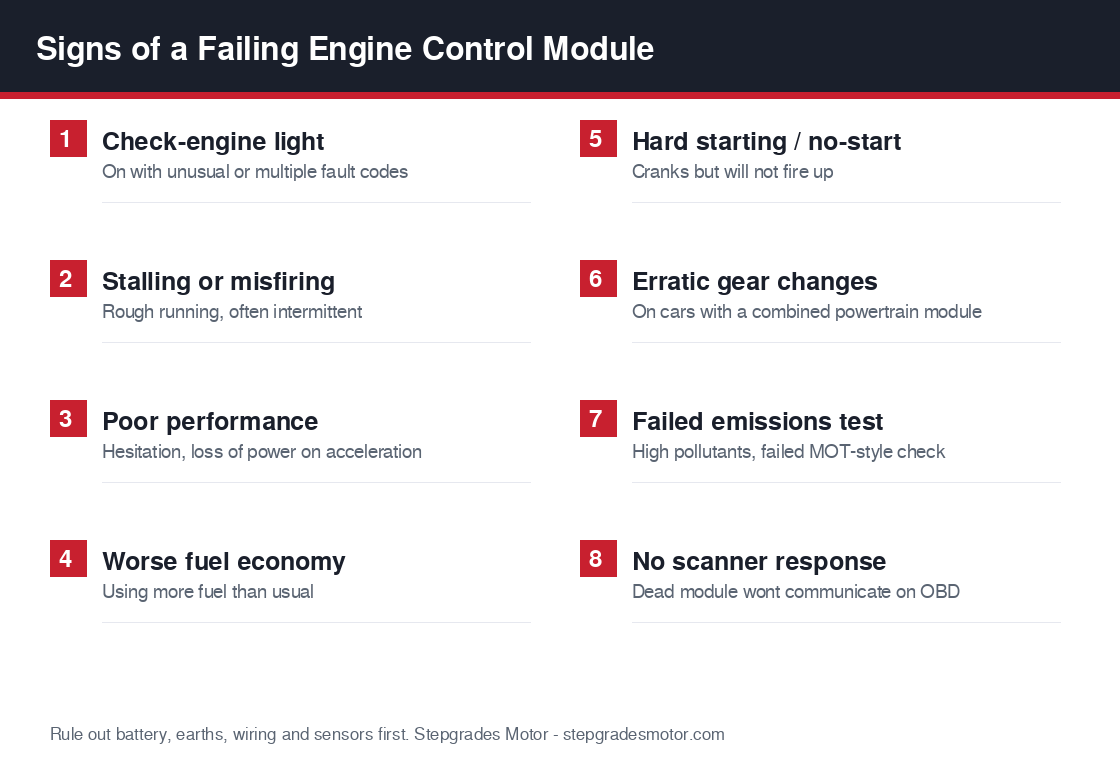
A faulty engine control module can produce a wide range of symptoms, which is exactly what makes it tricky to diagnose — its problems can mimic many other faults. Here are the most common warning signs.
1. Check-engine light
The most common sign. The engine control module itself lights the check-engine warning when it detects a fault — but if the module is failing, the light may come on with no obvious cause, or with unusual or multiple fault codes that don’t point to a single sensor.
2. Engine stalling or misfiring
If the module sends incorrect signals, the engine can misfire, run roughly, or stall unexpectedly — sometimes intermittently, which is a classic sign of an electronic rather than mechanical fault.
3. Poor performance and acceleration
A failing engine control module can upset the fuel-air mixture and ignition timing, leaving the engine down on power, hesitant when you accelerate, or generally sluggish.
4. Drop in fuel economy
If the module miscalculates how much fuel the engine needs, you may notice your car using noticeably more fuel than usual for the same driving.
5. Starting problems or a no-start
Because the engine can’t run without engine management, a failing module can make the car hard to start — and a complete failure can leave it unable to start at all, even though the starter turns the engine over.
6. Erratic behaviour and transmission issues
On vehicles with a combined powertrain control module, a fault can also cause erratic or harsh gear changes, since the same unit manages the transmission.
7. Failed emissions test
A module that’s mismanaging fuel and emissions systems can cause your car to fail its emissions or MOT-style test, with higher-than-allowed pollutants.
What causes an engine control module to fail?
Engine control modules are built to last, but several things can damage them. Knowing the causes helps you avoid repeat failures:
- Moisture and corrosion. Water getting into the module or its connectors — from leaks, flooding or a failed seal — is one of the most common causes of failure.
- Voltage spikes and electrical faults. Jump-starting incorrectly, a failing alternator, a bad battery, or short circuits can send damaging surges to the module.
- Heat and vibration. Years of engine-bay heat and vibration can eventually crack solder joints or components inside the module.
- Corroded or damaged wiring. Faulty wiring and connectors can mimic or cause module problems.
- Water damage during repairs. Pressure-washing the engine bay carelessly can force water into the module.
Often an ECU doesn’t fail on its own — it’s damaged by another fault, such as a bad earth, a failing charging system, or water ingress. Fixing the underlying cause is essential, or a replacement module may fail too.
How to diagnose an engine control module problem
Because its symptoms overlap with so many other faults, diagnosing an engine control module needs a methodical approach — ideally by a qualified technician. The process usually involves:
- Reading fault codes with a diagnostic scanner (OBD-II). Certain codes, or a pattern of unrelated codes, can point to the module.
- Checking the basics first — battery, earths, wiring and connectors — since these commonly cause ECU-like symptoms and are cheaper to fix.
- Inspecting the module for water damage, corrosion or burnt components.
- Testing power and signals to and from the module.
- Substitution testing — trying a known-good module (correctly coded) to confirm the fault.
The golden rule is to rule out the cheaper, more common causes — a flat battery, a corroded earth, a faulty sensor or damaged wiring — before condemning the engine control module itself. Many “dead ECUs” turn out to be wiring or power-supply problems.
Can you drive with a faulty engine control module?
It’s not advisable. A failing engine control module can cause unpredictable behaviour — sudden stalling, loss of power or a no-start — which can be dangerous, especially at speed or in traffic. It can also allow the engine to run with the wrong fuel mixture or timing, which over time may damage other components such as the catalytic converter.
If you suspect an ECU fault, the safest course is to have it diagnosed promptly rather than continuing to drive. At best you risk being stranded; at worst you could cause further, more expensive damage.
Fixing an engine control module: repair, reprogram or replace
There are three main routes to fixing a faulty engine control module, depending on what’s wrong:
Repair
Specialist ECU repair companies can sometimes fix a module at component level — re-soldering joints, replacing failed capacitors, or repairing water damage. This is often the most economical option when the fault is repairable, and it keeps your original, already-coded module.
Reprogram or reflash
Sometimes the hardware is fine but the software is corrupted, or the module needs updating. Reprogramming (reflashing) can resolve certain faults without new hardware.
Replace
If the module is beyond repair, it must be replaced. The replacement must match your vehicle exactly and, crucially, be coded or programmed to your car — paired with the immobiliser and keys — or the car won’t run. This coding usually requires specialist equipment, so a replacement ECU is not simply “plug and play” on most modern cars.
How long does an engine control module last?
There’s no fixed lifespan for an engine control module — unlike a timing belt or brake pads, it isn’t a scheduled service item. In normal use, a module is designed to last the lifetime of the vehicle, and many never need replacing at all. When failures do happen, they’re usually the result of an external cause rather than simple wear: water getting in, an electrical surge, a charging fault, or physical damage.
That said, age does play a part. On older, high-mileage vehicles, decades of heat, vibration and the occasional moisture exposure can eventually take their toll on the electronics inside. The practical takeaway is reassuring: look after the basics — a healthy battery and charging system, sound earths, and keeping water away from the module — and your engine control module will very likely outlast many other parts of the car.
Can you replace an engine control module yourself?
Physically swapping an engine control module can look deceptively simple — it’s often just a case of unplugging the connectors and unbolting the unit. The complication is almost never the mechanical part; it’s the coding. On the vast majority of modern cars, a replacement module must be electronically paired with the vehicle’s immobiliser, keys and specification before the engine will start, and that requires specialist diagnostic equipment and software.
For that reason, replacing an engine control module is usually a job for a qualified technician or an auto-electrical specialist, even if you’re a confident home mechanic. Some suppliers offer modules pre-coded to your vehicle using your VIN, which can simplify the job, but many still require final coding on the car. Before you buy or attempt a swap, always confirm exactly what coding is needed and who will carry it out — getting this wrong is the single most common reason a replacement ECU fails to bring the car back to life.
Engine control module or something else? Telling faults apart
Because a failing engine control module can imitate so many other problems, it’s worth knowing how it compares with the cheaper, more common faults it’s often confused with. A flat or failing battery causes slow cranking and electrical glitches, but is quickly confirmed with a simple battery test. A bad alternator gives a battery-warning light and dimming electrics. A faulty sensor — such as a crank, air-flow or oxygen sensor — typically triggers a specific, repeatable fault code pointing to that exact part. Corroded earths or wiring cause intermittent, hard-to-trace symptoms.
A genuine engine control module fault, by contrast, often shows up as multiple unrelated fault codes, communication errors, or a dead module that won’t respond to the diagnostic scanner at all. This is exactly why a methodical technician checks the battery, charging system, earths and sensors first — they’re far more common and much cheaper to fix. Only once those are ruled out should attention turn to the module itself. Jumping straight to an expensive ECU replacement is one of the most common and costly mistakes in diagnosis.
How much does engine control module replacement cost in Europe?
Costs vary widely by make, model and the route you take. A specialist repair of a faulty module is often the cheapest option when it’s possible. A used or reconditioned module, correctly coded, usually costs less than a brand-new one. A new OEM module is the most expensive, and you must add the cost of coding/programming it to your vehicle, which requires specialist equipment and labour.
Because the coding step is essential and varies by vehicle, always factor it into any quote. When comparing options, a quality used or reconditioned engine control module from a reputable supplier — coded to your car — frequently offers the best balance of cost and reliability, especially on older vehicles where a new OEM unit is poor value.
Buying a replacement engine control module
If you need a replacement, buying carefully matters just as much as it does with an engine. Keep these points in mind:
- Match the part number exactly. The engine control module must be the correct part for your specific vehicle — engine, year and specification. Quote your VIN and the number on the old unit.
- Confirm coding requirements. Ask whether the module will be pre-coded to your vehicle or needs coding after fitting, and who will do it.
- Buy from a reputable supplier who tests units and offers a warranty.
- Fix the root cause first. If water or a charging fault killed the original, sort that out or the replacement may fail too.
It’s also worth keeping your old module even once you’ve fitted a replacement, rather than scrapping it. A specialist may be able to repair the original unit as a spare, and the part number and coding information on it are useful references. A faulty ECU still has value, both as a repairable core and as a guide to sourcing the correct replacement.
You’ll find engine control modules and related electronics among our car parts and accessories. If you’re unsure which module your car needs, send us your registration and we’ll help you identify the right part.
The engine control module and buying a used engine
If you’re replacing a whole engine rather than just the module, the ECU is an important part of the conversation. Some used engines are sold with their original engine control module included, others as a bare unit. Where the ECU is included, it may still need coding to your vehicle, and the immobiliser system must be matched.
This is one more reason to buy from a specialist who understands fitment: a good supplier will tell you exactly what’s included with an engine and advise on the ECU and immobiliser side. To learn more about choosing a replacement engine, see our guides on how to buy a used engine in Europe en Uitleg over auto-onderdelen, or browse our range of inspected motoren van tweedehands auto’s.
Frequently asked questions
What is an engine control module (ECU/ECM)?
What are the symptoms of a bad engine control module?
What causes an engine control module to fail?
Can I drive with a faulty engine control module?
Can an engine control module be repaired, or must it be replaced?
The bottom line
The engine control module is the brain of your engine — a compact computer that manages fuel, timing, idle and emissions every second you drive. When it starts to fail, the symptoms are varied and easily mistaken for other problems: warning lights, stalling, poor performance, bad fuel economy or starting trouble. The key is methodical diagnosis that rules out cheaper causes like battery, earths and wiring first, before condemning the module. Depending on the fault, repair, reprogramming or a correctly coded replacement will get you back on the road.
If you need a replacement module, engine or parts, buy from a specialist who tests units, confirms fitment and advises on coding. Browse our car parts and accessories or inspected used engines, read our guide on car engine parts, of contact our team with your registration and we’ll help you find exactly the right part for your vehicle.
 English
 Deutsch
 Français
 Italiano
 Español
 Nederlands
 Polski