
Blog
Two-Stroke vs Four-Stroke Engines: Key Differences

From the whine of a chainsaw to the smooth hum of a family car, the world runs on two very different kinds of combustion engine: the two-stroke and the four-stroke. Understanding the difference explains a lot about how engines work, why your car uses the type it does, and where each design shines. This guide compares two stroke motors and four-stroke engines in plain language — how each works, their key differences, pros and cons, and where you’ll find them — for readers across the UK and Europe.
O godz. Silnik Stepgrades we supply imported, inspected car and truck engines — all of them four-stroke — to drivers and garages across Europe, and “what’s the difference between a two-stroke and a four-stroke?” is a question we hear often. By the end of this article you’ll understand both designs clearly, know why cars settled on the four-stroke, and see where two-stroke motors still earn their place.
What is a two-stroke motor?
A two-stroke motor is an internal combustion engine that completes its power cycle in just two movements of the piston — one up and one down — which equals a single turn of the crankshaft. Because it fires once every revolution, a two-stroke produces a power stroke twice as often as a four-stroke at the same engine speed, giving it a strong power-to-weight ratio for its size.
Two-stroke motors are mechanically simple: they typically have no valves, using ports in the cylinder wall that the piston covers and uncovers as it moves. They also usually mix oil with the fuel for lubrication, rather than having a separate oil system. This simplicity makes them light, cheap and powerful for their size — but, as we’ll see, it comes with trade-offs in efficiency, emissions and longevity.
What is a four-stroke engine?
A four-stroke engine completes its cycle in four movements of the piston — intake, compression, power and exhaust — which takes two full turns of the crankshaft. It fires once every two revolutions, so it produces fewer power strokes than a two-stroke at the same speed, but it does so far more cleanly and efficiently.
Four-stroke engines use valves to control the flow of air and exhaust, and they have a separate lubrication system with an oil sump, so fuel and oil stay apart. This makes them more complex and a little heavier, but much more fuel-efficient, cleaner-running and longer-lasting. Almost every car, truck and motorcycle of any size uses a four-stroke engine — the same type we cover in our guide on how a car engine works.
How a two-stroke engine works
In a two-stroke motor, the two strokes combine several jobs at once. As the piston rises, it compresses the fuel-air mixture above it while simultaneously drawing a fresh charge into the crankcase below. Near the top, the spark ignites the mixture. As the piston is driven down on the power stroke, it both delivers power and pushes the fresh charge up into the cylinder, while exhaust gases escape through the exhaust port. Intake, compression, combustion and exhaust all happen within those two strokes, overlapping rather than being neatly separated.
This overlapping process is what makes two-stroke motors so compact and powerful for their weight, but also why some fuel and oil escape unburnt — the source of their characteristic smoke and higher emissions.
How a four-stroke engine works
A four-stroke engine separates the four jobs into distinct strokes. On the intake stroke the piston draws in air and fuel; on compression it squeezes the mixture; on the power stroke the ignited mixture drives the piston down; and on the exhaust stroke the spent gases are pushed out. Valves open and close to manage each phase precisely, and a separate oil system keeps everything lubricated without burning oil in the process. The video below compares both designs side by side.
Two-stroke vs four-stroke: the key differences
The two designs differ in almost every practical respect. Here are the differences that matter most.
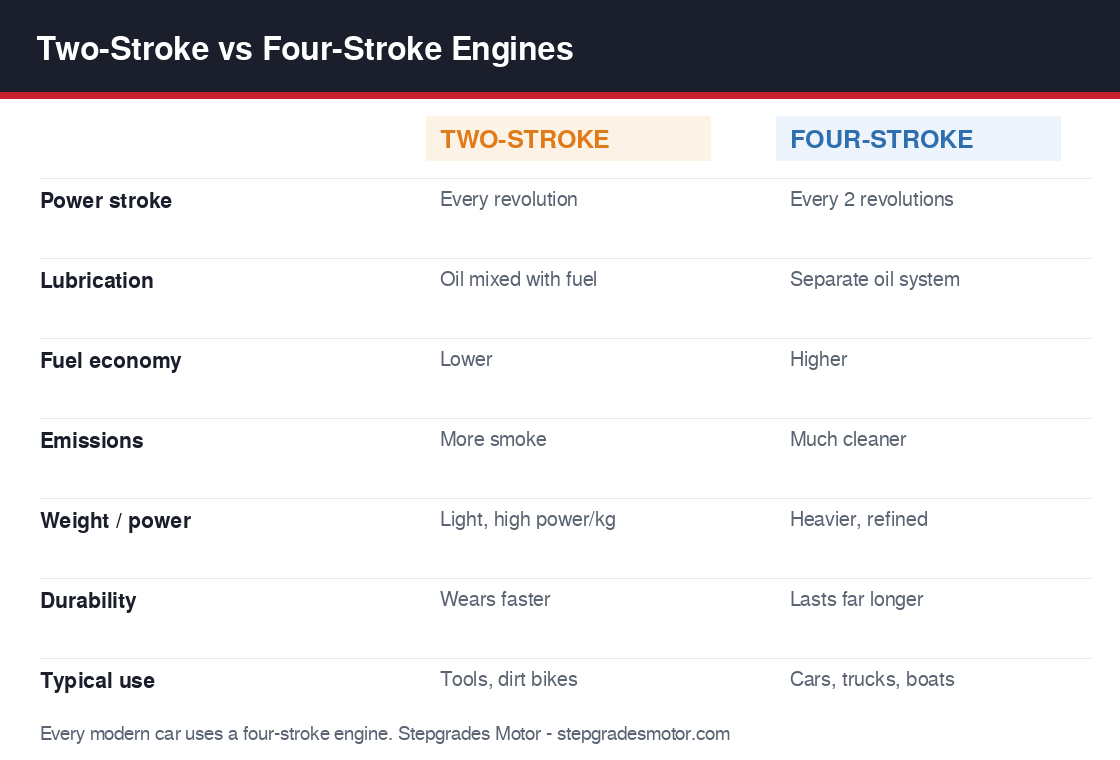
- Power cycle. Two-stroke: one power stroke per crankshaft revolution. Four-stroke: one every two revolutions.
- Power-to-weight. Two-strokes are lighter and more powerful for their size; four-strokes are heavier but more refined.
- Lubrication. Two-strokes burn a fuel-oil mix; four-strokes have a separate oil system.
- Fuel efficiency. Four-strokes are significantly more economical.
- Emissions. Two-strokes produce more smoke and pollutants; four-strokes are much cleaner.
- Complexity. Two-strokes are mechanically simpler (often no valves); four-strokes have valves and more parts.
- Durability. Four-strokes generally last far longer; two-strokes wear faster.
- Maintenance. Two-strokes need fuel mixing but are simple to fix; four-strokes need regular oil changes.
- Noise. Two-strokes have a distinctive high-pitched buzz; four-strokes run deeper and smoother.
A brief history of the two-stroke and four-stroke
Both designs have deep roots in engineering history. The four-stroke cycle was developed by Nikolaus Otto in the 1870s — which is why it’s still sometimes called the “Otto cycle” — and it quickly became the basis for the motor car. Its efficiency and smoothness made it the natural choice as vehicles grew and had to run reliably for long distances.
The two-stroke, refined by engineers including Dugald Clerk and later Joseph Day, offered a simpler, lighter alternative that produced more power for its size. Through the twentieth century it powered everything from small cars and motorcycles to boats and tools. Over time, though, rising fuel costs and tightening emissions laws steadily pushed cars and larger machinery firmly towards the four-stroke, leaving two-stroke motors to the niches where their light weight and simplicity still matter most. Understanding this history helps explain why the two designs ended up serving such different roles today.
The pros and cons of two-stroke motors
Two-stroke motors have clear strengths that keep them in use for specific jobs:
- Pros: light and compact, high power for their size, mechanically simple and cheap to build, can run in any orientation (useful for handheld tools), and easy to repair.
- Cons: higher fuel consumption, more emissions and smoke, shorter lifespan, the need to mix oil with fuel, and more frequent rebuilding in hard use.
In short, two-stroke motors trade efficiency, cleanliness and longevity for simplicity, light weight and power density.
The pros and cons of four-stroke engines
Four-stroke engines dominate for good reasons:
- Pros: far more fuel-efficient, much cleaner emissions, longer lifespan, smoother and quieter running, and no need to mix fuel and oil.
- Cons: heavier and more complex, more expensive to build and repair, and require regular oil changes and valve maintenance.
For anything that runs a lot, carries people, or must meet emissions rules — above all, cars — the four-stroke’s efficiency, cleanliness and durability win easily.
Where are two-stroke motors used?
Thanks to their light weight and power density, two-stroke motors are found wherever those qualities matter more than efficiency or emissions:
- Handheld garden and power tools — chainsaws, strimmers, leaf blowers and hedge trimmers, where light weight and any-orientation running are essential.
- Small motorcycles, mopeds and scooters, especially older or budget models.
- Outboard boat motors, particularly smaller and older ones.
- Jet skis, snowmobiles and off-road dirt bikes, where power-to-weight is prized.
- Model engines and some generators and pumps.
Tightening emissions rules across Europe have pushed many of these applications towards cleaner four-stroke or electric alternatives, but two-stroke motors remain common in tools and light machinery.
Where are four-stroke engines used?
Four-stroke engines power the overwhelming majority of vehicles and larger machinery, including:
- All cars and trucks — every modern road car uses a four-stroke engine.
- Larger motorcycles and most modern bikes.
- Vans, buses and commercial vehicles.
- Larger marine engines, generators and industrial machinery.
- Most modern outboard motors, which have largely switched to four-stroke for efficiency and emissions.
Whenever an engine must run efficiently for long periods, meet emissions standards and last for years, the four-stroke is the natural choice — which is exactly why it’s universal in cars.
Why do cars use four-stroke engines?
Cars settled on the four-stroke engine for a simple reason: it’s the best all-round balance of efficiency, cleanliness, refinement and durability — exactly what a vehicle driven daily for years needs. A two-stroke motor’s higher fuel use, greater emissions and shorter lifespan would be unacceptable in a modern car, especially under Europe’s strict emissions regulations.
The four-stroke’s separate lubrication system also means it doesn’t burn oil with its fuel, so it runs cleaner and lasts far longer — essential for an engine expected to cover a hundred thousand miles or more. Add in smoother, quieter running, and the four-stroke is simply better suited to the job. This is why every engine we supply, from small petrol units to large diesels, is a four-stroke.
Two-stroke vs four-stroke for marine and outdoor use
One area where the debate is still lively is marine and outdoor power. Older outboard boat motors were often two-stroke, prized for light weight and strong power delivery. Modern outboards, however, have largely moved to four-stroke (or advanced direct-injection two-stroke) designs for better fuel economy, quieter running and far lower emissions — important on the water, where fuel and pollution matter.
For garden tools, two-stroke motors persist because light weight and the ability to run at any angle are so valuable in handheld equipment, though battery-electric tools are rapidly taking over. The trend everywhere is the same: as efficiency and emissions become more important, four-stroke and electric options steadily replace two-stroke motors, except where simplicity and power-to-weight remain decisive.
Maintenance and running costs compared
The two designs are looked after quite differently. A two-stroke motor needs you to get the fuel-oil mixture right — either pre-mixing oil with the petrol or keeping an oil-injection reservoir topped up. Get the ratio wrong and you risk either poor lubrication and seizure, or excessive smoke and fouling. On the plus side, with no valvetrain or separate oil system, two-strokes are mechanically simple and cheap to repair or rebuild, which suits tools and machines used occasionally.
A four-stroke engine doesn’t need fuel mixing, but it does require regular oil and filter changes and periodic attention to the valvetrain and timing components. In return, it uses far less fuel and lasts much longer, so despite the servicing, its running costs over a long life are usually lower for anything used regularly. For a car covering thousands of miles a year, the four-stroke’s efficiency and durability make it dramatically cheaper to run than a two-stroke of similar output ever could be — another reason cars never looked back.
Direct-injection two-strokes and the future
The two-stroke isn’t standing still. Modern direct-injection two-stroke engines, found in some advanced outboard motors and specialist applications, inject fuel precisely after the exhaust port closes, dramatically cutting the unburnt fuel and emissions that plagued older designs. These engines recover much of the two-stroke’s light weight and power advantage while running far cleaner, keeping the design relevant where power-to-weight is critical.
Even so, the broad direction of travel is clear. Across Europe, tightening emissions rules and the rise of battery-electric power are steadily replacing traditional two-stroke motors in tools, scooters and small boats. Four-stroke engines remain the backbone of road transport for now, though they too face a long-term shift towards electrification. For the foreseeable future, however, your car will be powered by a four-stroke engine, and understanding both designs helps you make sense of the machines around you.
Common two-stroke and four-stroke problems
Each design has its own typical faults. Two-stroke motors commonly suffer from fouled spark plugs, carbon build-up in the exhaust port and on the piston, and seizure if the oil mix is wrong or they overheat — all made worse by poor-quality fuel or incorrect mixing. Because they wear faster, high-use two-strokes may need rebuilding periodically.
Four-stroke engines are more durable but have more systems that can fail: worn piston rings, valve and valve-seal issues, timing belt or chain wear, and head-gasket problems, alongside the many ancillaries a modern engine carries. The upside is that, maintained properly, a four-stroke car engine can cover enormous mileages reliably. When one does reach the end of its life, fitting a sound replacement is usually far more economical than a major rebuild — the same logic that applies to any car engine.
Which is better, two-stroke or four-stroke?
Neither is simply “better” — each suits different needs. A two-stroke motor is better when light weight, simplicity and power-to-weight matter most, and efficiency and emissions matter least: think chainsaws, dirt bikes and light handheld tools. A four-stroke engine is better when efficiency, cleanliness, refinement and long life matter: cars, trucks, modern motorcycles and larger machinery.
For anything you drive on the road, the four-stroke wins decisively, which is why it’s universal in cars. For a quick, light, powerful tool you use occasionally, a two-stroke motor still makes sense. The right choice simply depends on the job.
It’s also worth remembering that the two designs aren’t really competing for the same work any more. Decades ago they overlapped in cars, motorcycles and boats, and the “which is better” question was a genuine contest. Today they’ve largely settled into separate roles: the four-stroke for anything that runs long and hard, the two-stroke for light, intermittent power. So rather than one design beating the other, each has found the niche where its particular strengths matter most — which is exactly why both are still with us.
How to tell if an engine is two-stroke or four-stroke
If you’re ever unsure which type a small engine is — on a tool, bike or outboard — a few quick checks usually give it away. The clearest sign is how it’s fuelled and lubricated: a two-stroke motor requires oil to be mixed with the petrol (or has an oil-injection reservoir), whereas a four-stroke has a separate oil filler and dipstick and runs on straight petrol. If you add two-stroke oil to the fuel, it’s a two-stroke; if you check and change engine oil separately, it’s a four-stroke.
Other clues help too. Two-stroke motors have a higher-pitched, buzzy exhaust note and often a visible haze of smoke, while four-strokes sound deeper and smoother and run cleaner. Two-strokes are usually lighter and simpler, with ports rather than obvious valve covers. On a car there’s no need to check at all — every modern car is a four-stroke. But for garden tools and small machines, these simple tests tell you instantly which type you’re dealing with, and therefore how to fuel and maintain it correctly.
What this means for car owners
For everyday motorists, the practical takeaway is straightforward: your car has a four-stroke engine, and any replacement must be the same. You’ll never fit a two-stroke motor to a car — the two designs are entirely different in construction and purpose. Understanding the distinction simply helps you appreciate how your engine works and why it’s built the way it is.
When the time comes to replace a car engine, the principles are the same as for any four-stroke: match the engine code, choose a tested, low-mileage unit, and buy from a reputable supplier. To learn more, read our guides on the rodzaje silników samochodowych oraz Części silnika samochodowego – objaśnienie, or browse our range of inspected używane silniki samochodowe. If you’re unsure which engine your car needs, send us your registration and we’ll confirm it.
Frequently asked questions
What is the main difference between two-stroke and four-stroke motors?
Why do cars use four-stroke engines instead of two-stroke?
Do two-stroke motors need oil mixed with fuel?
Are two-stroke motors more powerful than four-stroke?
Can a car have a two-stroke engine?
The bottom line
Two-stroke motors and four-stroke engines solve the same problem — turning fuel into motion — in very different ways. The two-stroke fires every revolution, making it light, simple and powerful for its size, but thirsty, dirtier and shorter-lived. The four-stroke fires every other revolution through four distinct strokes, making it more efficient, cleaner, smoother and far more durable. That’s why two-strokes rule in chainsaws and dirt bikes, while four-strokes power every car on the road.
For car owners, the message is simple: your engine is a four-stroke, and a replacement must be too. If you need one, browse our inspected używane silniki samochodowe, read our guides on how a car engine works and the rodzaje silników samochodowych, albo contact our team with your registration and we’ll help you find the right engine for your vehicle.
 English
 Deutsch
 Français
 Italiano
 Español
 Nederlands
 Polski