
Blog
What Is a Reconditioned Engine? Reconditioned vs Used vs Rebuilt Explained

If you’re shopping for a replacement engine, one question comes up again and again: what is a reconditioned engine, and how is it different from a used or a rebuilt one? The terms are often used loosely — sometimes interchangeably — which makes it hard to compare prices and know exactly what you’re paying for. This guide clears up the confusion. We’ll explain precisely what reconditioning involves, how it compares with used and rebuilt engines, what it costs across Europe, and how to decide which option gives you the best value for your car.
O godz. Silnik Stepgrades we supply imported, inspected engines to drivers and garages across the UK and mainland Europe, and “reconditioned versus used” is one of the most common questions we’re asked. By the end of this article you’ll understand the real differences and be able to buy with confidence — whether you drive a Vauxhall in Britain, a Volkswagen in Germany, a Peugeot in France or a Fiat in Italy.
What is a reconditioned engine?
A reconditioned engine is a used engine that has been partially or fully dismantled, inspected, and had its worn components replaced or machined back toward the manufacturer’s original tolerances. In other words, reconditioning takes an engine that has done a lot of work, renews the parts most likely to wear out, and returns it to reliable, roadworthy condition.
Exactly how much is renewed varies from supplier to supplier, which is the crucial point to understand. A basic recondition might replace the bearings, seals, gaskets and piston rings. A more thorough one may also include machining the cylinder head, re-boring the block, and fitting new pistons. Because the word “reconditioned” isn’t tightly regulated, two engines described the same way can involve very different amounts of work — so always ask for a specification of what was actually done.
In short, the answer to “what is a reconditioned engine” is: a used engine that has been professionally refreshed to extend its reliable service life, sitting between a straightforward used unit and a full rebuild in both work and price.
How engine reconditioning works
Understanding the reconditioning process helps you judge quality and value. While every workshop has its own approach, a proper recondition follows a logical sequence. The short video below shows the kind of hands-on work involved.
1. Tear-down and inspection
The engine is stripped and every major component is inspected and measured. This reveals what is still within tolerance and what needs attention — worn bearings, scored bores, a warped head or tired valve seals.
2. Cleaning and machining
The block and head are thoroughly cleaned, then machined where needed — for example skimming the cylinder head flat, or re-boring and honing the cylinders so new pistons or rings seal correctly.
3. Replacing wear parts
The parts most likely to fail are renewed: bearings, seals, gaskets, piston rings, and often the timing components. This is where a thorough recondition earns its cost — it removes the weak points before they cause trouble.
4. Reassembly and testing
The engine is rebuilt to specification, torqued correctly, and — at a reputable supplier — tested or compression-checked before it’s offered for sale. That final check is what separates a quality reconditioned engine from a gamble.
Reconditioned vs used vs rebuilt: the key differences
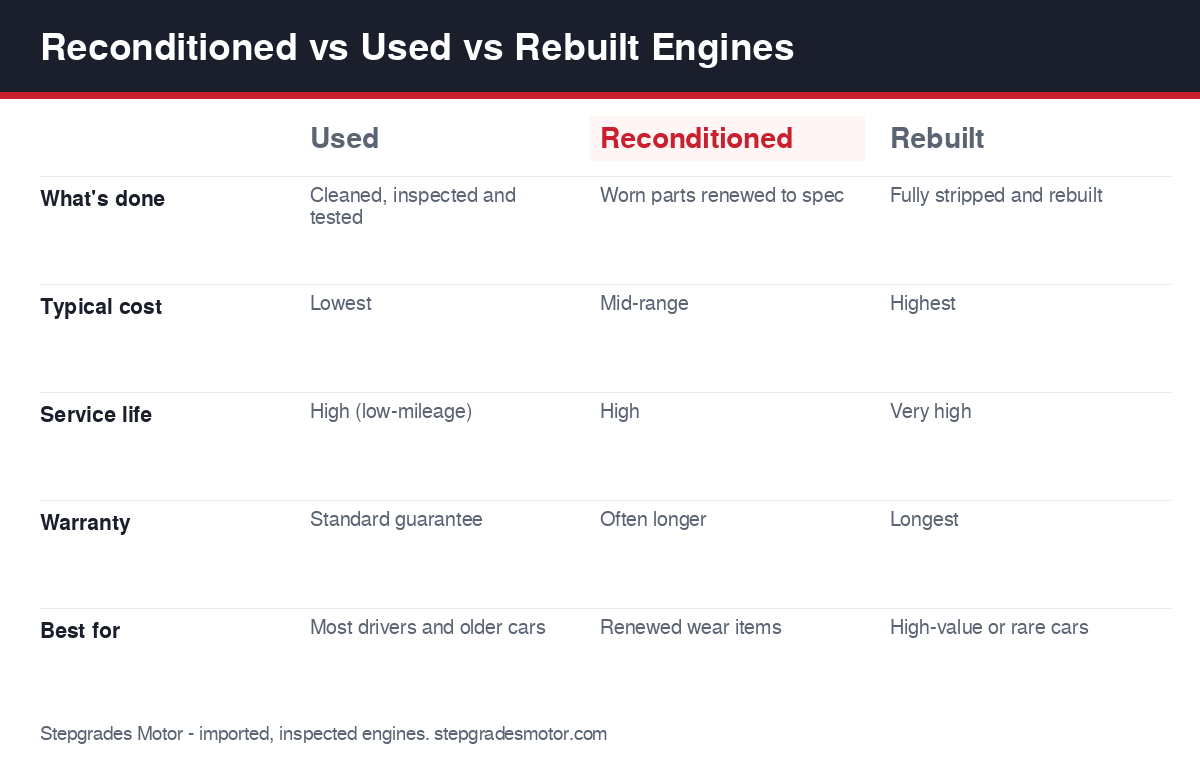
This is where most buyers get stuck, so let’s compare the four options you’ll see advertised. The infographic below summarises the differences at a glance.
Used (second-hand) engines
A used engine is a complete unit removed from a donor vehicle, then cleaned, inspected and compression-tested before sale — but not internally rebuilt. Low-mileage imported units are the best value here, offering plenty of service life at the lowest price. If you want the full process of choosing one, see our detailed guide on how to buy a used engine in Europe.
Reconditioned engines
As described above, a reconditioned engine has had its worn parts renewed to bring it back toward factory tolerances. It costs more than a straight used engine but typically carries a longer warranty and gives extra peace of mind, because the common failure points have already been addressed.
Rebuilt and remanufactured engines
A rebuilt — or “remanufactured” — engine is stripped completely and rebuilt to a defined specification, usually with the broadest range of new parts and the longest warranty. It’s the most expensive route and makes most sense for high-value, rare or hard-to-replace vehicles. “Remanufactured” generally implies a factory-standard process and documentation, while “rebuilt” can be done by any competent workshop.
New (OEM) engines
A brand-new engine from the manufacturer is the most expensive option and is rarely cost-effective for a car more than a few years old.
What affects the quality of a reconditioned engine?
Because the word “reconditioned” covers such a wide range of work, quality varies enormously — and knowing what drives it helps you compare offers fairly. Several factors make the difference between an engine that lasts and one that disappoints:
- The starting unit. A recondition built on a low-mileage, undamaged core is far stronger than one built on a worn, high-mileage block. Ask what the base engine was.
- The depth of work. Replacing only seals and gaskets is very different from machining the head, re-boring the block and fitting new pistons. More thorough work costs more but lasts longer.
- The quality of parts. OEM or reputable aftermarket components outlast the cheapest bargain-bin parts.
- The skill of the workshop. Correct machining and careful assembly to the right torque settings are essential — this is precision work, not guesswork.
- Testing. A supplier who compression-tests or runs the engine before sale is confident in their work; one who doesn’t is asking you to take a chance.
When two reconditioned engines carry very different prices, these factors usually explain the gap. The cheapest option often reflects a lighter recondition on a weaker core — which is why the specification, not just the price, should guide your decision.
How much does a reconditioned engine cost in Europe?
There’s no single figure, because cost depends on the make, engine size, how much work the recondition involved, and the parts used. As a general pattern across Europe, a reconditioned engine sits above a straightforward used engine and below a full rebuild. A small four-cylinder petrol unit will be at the lower end, while a larger diesel, a performance engine, or one needing extensive machining will cost considerably more.
When comparing quotes, the headline price is only half the story. Always ask:
- Exactly which parts were renewed (bearings and seals only, or pistons, head work and more)?
- Was the engine tested or compression-checked afterwards?
- What warranty is included, and what does it cover?
- Is delivery and fitting included, or extra?
Prices also vary from country to country across Europe, driven by local labour rates, parts availability and demand. Reconditioning a popular engine with readily available parts is usually cheaper than one for a rare or discontinued model, where components are harder to source. This is another reason buying a complete, tested engine from a specialist importer can beat a local recondition on both price and lead time — the unit is ready to ship rather than tied up in a workshop queue for weeks.
A cheaper recondition that cut corners is no bargain if it fails early. To see realistic, inspected pricing on complete engines, browse our range of używane silniki samochodowe.
Is a reconditioned engine worth it?
For many drivers, yes — but it depends on your goals and budget. A reconditioned engine is worth it when:
- You plan to keep the car for several more years and want maximum reliability.
- The vehicle is valuable or well looked-after, so the extra cost is justified.
- You want a longer warranty than a straight used engine typically offers.
A reconditioned engine may be unnecessary when a quality low-mileage used engine will do the job for less — for example on an older, lower-value car where you simply want dependable transport without paying for machining you don’t need. In that case, a tested used import is often the smarter spend.
Petrol vs diesel: does engine reconditioning differ?
The core principles of reconditioning are the same for petrol and diesel engines, but there are practical differences worth knowing. Diesel engines run at much higher compression and are built to tougher tolerances, so machining and assembly must be especially precise. They also carry extra components — turbochargers, high-pressure injectors, EGR valves and particulate filters — which may need attention or replacement depending on the recondition.
That complexity is one reason a reconditioned diesel engine typically costs more than an equivalent petrol unit, and why diesel reconditioning is best left to specialists. For high-mileage motorway cars common across Germany, France, Belgium and the Netherlands, a properly reconditioned diesel can be excellent value. For a small petrol city car, by contrast, a tested low-mileage used engine is often the more sensible spend. Either way, confirm exactly which ancillary components are included so there are no surprises on fitting day.
Reconditioned engine or replace the car?
Sometimes the real question isn’t used versus reconditioned, but whether to fit a replacement engine at all. As a rule of thumb, if the cost of a reconditioned or used engine — including fitting — is comfortably less than the value of your car and the rest of the vehicle is sound, replacing the engine is the smart, economical choice. You keep a car you already know and trust, avoid the cost and hassle of buying another vehicle, and often get years of further use.
Replacing the car tends to make more sense only when the vehicle has other serious problems — significant rust, failing transmission, or extensive wear elsewhere — that would also need expensive attention. If the engine is the only major issue, a quality reconditioned or used unit is almost always the better-value path. A trusted mechanic can help you weigh the specific numbers for your car.
Reconditioned vs used: which is better value?
This is the decision most buyers really care about, so let’s be direct. A low-mileage used engine usually offers the best price and, if it’s a genuine low-mileage import, plenty of service life — making it the value champion for most everyday cars. A reconditioned engine costs more but reduces the risk of early wear-part failure and often comes with a longer guarantee, which can be worth it on a car you intend to keep.
The honest answer: if budget is the priority and you can buy a verified low-mileage used unit, used wins on value. If long-term peace of mind matters more and the car justifies it, reconditioned is the safer choice. Either way, the golden rules are the same — match the engine by code, insist on testing, and buy from a supplier who stands behind the unit. Need a matching gearbox or transmission too? Buying a matched pair from one supplier avoids compatibility headaches.
What to check before buying a reconditioned engine
Because “reconditioned” means different things to different sellers, due diligence matters even more than with a straight used engine. Before you buy:
- Get the reconditioning specification in writing — which parts were replaced and what machining was done.
- Confirm the engine code matches your vehicle. You’ll find it on the block and referenced on your vehicle papers; in the UK, cross-check your V5C registration document, and other European countries have equivalents.
- Ask about testing — compression results or a test run give real reassurance.
- Read the warranty — period, coverage, and any conditions such as professional fitting.
- Check delivery — a heavy engine should travel on a secured pallet with tracked freight.
Buying a reconditioned engine online safely
Most engine purchases across Europe now begin online, which gives you far more choice than your local area — but only if you buy carefully. The reassuring news is that a reputable specialist can offer better value and more accountability than an anonymous local seller, provided you follow a few sensible rules.
- Buy from a seller who states the engine code and mileage for each unit, and who confirms fitment for your registration before you pay.
- Insist on testing or inspection evidence. A genuine specialist will happily share compression results or describe the checks performed.
- Get the warranty and reconditioning specification in writing before you commit.
- Check delivery and packaging. A heavy engine must travel on a secured pallet with tracked freight; flimsy packing invites transit damage.
- Be wary of prices that look too good to be true. A suspiciously cheap “reconditioned” engine often means a light recondition on a weak core — or no real work at all.
Follow those steps and buying online is safe, convenient and usually cheaper than the alternatives. If you’re ever unsure, ask the supplier directly — a trustworthy one will answer every question clearly.
Warranty and fitting across Europe
One of the main reasons to choose a reconditioned engine is the warranty, so understand it fully. A good guarantee covers internal mechanical failure for a defined period, provided the engine is fitted correctly and maintained. Most suppliers require professional fitting and the correct oil to keep cover valid.
Fitting itself is the ideal time to renew remaining service items — timing belt or chain, water pump and ancillary gaskets — which protects your investment. Across Europe, reconditioned and used engines alike should be dispatched on secured pallets with tracked freight; at Stepgrades Motor we deliver UK-wide and across mainland Europe and can confirm fitment for your exact vehicle before you order.
Reconditioned engines for popular European cars
Demand for reconditioned and used engines is strong across Europe’s best-selling models. Owners of the Vauxhall/Opel Corsa and Astra, Volkswagen Golf and Polo, Ford Fiesta and Focus, Renault Clio, Peugeot 208 and Fiat 500 all look for cost-effective engine replacements as their cars age. Diesel owners in Germany, France and beyond often favour a reconditioned unit for the extra reliability on high-mileage motorway cars, while petrol city-car owners frequently find a low-mileage used engine is the most economical fix.
Whatever you drive, the approach is identical: identify the correct engine by code, decide whether used or reconditioned suits your budget and plans, and buy from a specialist who tests units and confirms fitment. If you’re unsure which option is right for your car, contact our team with your registration and we’ll advise honestly.
Your reconditioned engine buyer’s checklist
Before you commit to any reconditioned engine, run through this quick recap to make sure you’re getting genuine value:
- ✅ You’ve seen the reconditioning specification — exactly which parts were renewed and what machining was done
- ✅ The engine code is confirmed against your vehicle
- ✅ You know the base unit’s condition and mileage
- ✅ The engine was tested or compression-checked
- ✅ The warranty terms are clear and in writing
- ✅ Tracked, palletised delivery to your country is arranged
- ✅ You’ve compared it fairly against a low-mileage used engine for value
Tick every box and you can be confident you’re buying a quality reconditioned engine — not an unknown quantity dressed up with a flattering label.
Common myths about reconditioned engines
- “Reconditioned means like-new.” Not necessarily — it means worn parts have been renewed. The quality depends entirely on how thorough the work was, which is why the specification matters.
- “Reconditioned is always better than used.” A genuine low-mileage used engine can offer excellent value and long life. “Better” depends on your car, budget and how long you’ll keep it.
- “All reconditioned engines are the same.” They aren’t. A basic seal-and-gasket recondition is very different from one involving machining and new pistons.
- “A reconditioned engine will void my insurance or fail inspection.” Fitting the correct engine type with intact emissions equipment keeps your car compliant and insurable.
Frequently asked questions
What is a reconditioned engine, in simple terms?
Is a reconditioned engine better than a used engine?
How long does a reconditioned engine last?
What’s the difference between reconditioned and rebuilt?
Do you deliver reconditioned and used engines across Europe?
The bottom line
So, what is a reconditioned engine? It’s a used engine professionally refreshed — worn parts renewed to restore reliable performance — offering a middle path between a straightforward used unit and a full rebuild. Whether reconditioned or used is right for you comes down to budget, the value of your car, and how long you’ll keep it. Match by engine code, insist on testing and a clear warranty, and buy from a specialist who confirms fitment and delivers properly across Europe.
Ready to find the right engine for your vehicle? Browse our inspected używane silniki samochodowe, read our companion guide on buying a used engine, albo skontaktuj się z nami with your registration and we’ll recommend the best option for your car and budget.
 English
  Deutsch
  Français
  Italiano
  Español
  Nederlands
  Polski