
Blog
Guida ai tipi di motori per auto (benzina, diesel, ibridi e altro)

Walk through any car park in Europe and you’re looking at a huge variety of engines — petrol and diesel, hybrids and electrics, small three-cylinders and big V8s, turbocharged and naturally aspirated. With so many types of engine on the road, it’s easy to get lost in the jargon. This guide cuts through it, explaining every major type of car engine in plain language: how they’re grouped by fuel, by layout and by size, what each one is good at, and how to choose the right one for your needs.
A Motore Stepgrades we supply imported, inspected engines of many types to drivers and garages across the UK and mainland Europe, so we know how much the right choice matters. Whether you’re curious about how hybrids differ from plug-in hybrids, wondering what a “boxer” engine is, or trying to decide which type suits your driving, by the end of this article you’ll understand the full picture — and what it means if you ever need to replace your engine.
Why there are so many types of engine
Engines have evolved over more than a century to meet very different needs. A city runabout, a long-distance motorway cruiser, a sports car and a work van all demand different things from their power unit — economy, torque, smoothness, performance or low emissions. Manufacturers have answered with an enormous range of designs, each balancing those priorities differently.
To make sense of them, it helps to group the types of engine in three ways: by the fuel or power source they use, by the layout of their cylinders, and by their size and number of cylinders. Most descriptions you’ll see — a “1.5-litre turbo petrol inline-four”, say — simply combine these three dimensions. Once you understand each one, every engine spec suddenly makes sense.
Europe has shaped this variety more than most regions. Tightening emissions standards, fuel prices, city low-emission zones and a long tradition of high-mileage motorway driving have all pushed manufacturers to offer a wide spread of engine types for the same model — a single car might be sold as petrol, diesel, mild hybrid and full hybrid across different markets. That’s why understanding the types of engine matters so much to European drivers in particular: the choice directly affects what you pay to run the car, where you can drive it, and which replacement unit you’ll need if the engine ever fails.
Types of engine by fuel and power source
This is the division most drivers care about first, because it affects running costs, emissions and how the car feels to drive. Here are the main types.
Petrol (gasoline) engines
The most common type of engine in passenger cars across Europe. A petrol engine mixes fuel and air and ignites it with a spark plug. Petrol engines are smooth, rev freely and are cheaper to buy and repair, which makes them ideal for smaller cars and lower-mileage drivers. They’re generally less fuel-efficient than diesels on long journeys but suit city and mixed driving well.
Diesel engines
A diesel engine compresses air until it’s hot enough to ignite the fuel on its own, with no spark plug — known as compression ignition. Diesels deliver more low-down torque and better fuel economy over distance, which is why they dominate among high-mileage motorway drivers, larger vehicles and vans across Germany, France, Belgium and the Netherlands. They cost a little more to build and service but can be very economical for the right driver.
Hybrid engines (HEV)
A hybrid pairs a conventional petrol (or occasionally diesel) engine with an electric motor and a small battery. The electric motor assists at low speeds and in traffic, while the combustion engine takes over at higher speeds or when more power is needed. The battery recharges as you drive, so you never plug it in. Hybrids improve fuel economy and cut emissions in town, making them popular for urban and mixed driving.
Plug-in hybrid engines (PHEV)
A plug-in hybrid is similar but with a larger battery that you charge from the mains. This lets it travel a meaningful distance — often several dozen kilometres — on electric power alone before the combustion engine is needed. PHEVs suit drivers who do short commutes electrically but still want a petrol or diesel engine for longer trips without range worries.
Mild hybrid engines (MHEV)
Increasingly common on new European cars, a mild hybrid adds a small electric system — often a 48-volt starter-generator — to a conventional petrol or diesel engine. Unlike a full hybrid, it can’t drive the car on electricity alone; instead it assists the engine, enables smoother stop-start, and recovers energy under braking to shave fuel use and emissions. It’s a subtle but widespread evolution of the traditional combustion engine rather than a separate powertrain, which is why you’ll find mild-hybrid versions of many familiar petrol and diesel models.
Fully electric (EV)
Strictly speaking, a fully electric car has no engine at all in the traditional sense — it uses one or more electric motors powered by a large battery, with no combustion, no cylinders and no exhaust. We include EVs here for completeness, since they’re part of the modern powertrain landscape, but the rest of this guide focuses on combustion engines, which still power the vast majority of cars on European roads.
LPG and alternative-fuel engines
Some petrol engines are converted or built to run on liquefied petroleum gas (LPG) or other alternative fuels, which can lower running costs and emissions. These remain a niche but useful option in certain European markets. The video below compares the main fuel types side by side.
Types of engine by cylinder layout
The second way to classify engines is by how their cylinders are physically arranged. The layout affects the engine’s size, smoothness, sound and where it fits in the car.
Inline (straight) engines
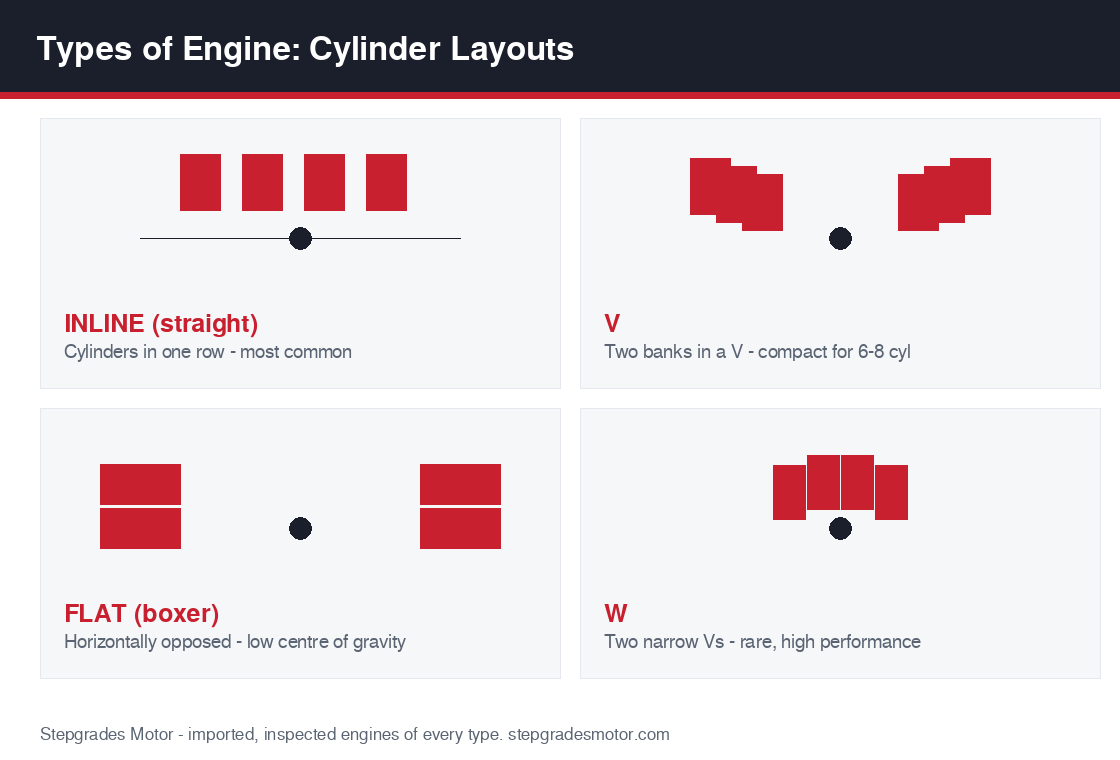
The cylinders sit in a single row. This is by far the most common layout in everyday European cars, used in most three- and four-cylinder models. It’s simple, compact and economical to build, and an inline-four in particular offers a good balance of smoothness and cost.
V engines
Two banks of cylinders are set at an angle to each other, forming a “V”. This keeps a six-, eight- or twelve-cylinder engine shorter than it would be in a straight line, so it fits more easily under the bonnet. V6 and V8 engines are common in larger, more powerful and premium cars.
Flat (boxer) engines
Here the cylinders lie horizontally opposed, pointing away from each other on either side of the crankshaft. This “boxer” layout gives a low centre of gravity, which improves handling, and is used by a few manufacturers known for sports and all-wheel-drive cars. It’s less common but distinctive.
W and other layouts
A handful of high-performance and luxury cars use a “W” configuration, effectively combining two narrow V shapes to pack many cylinders into a compact space. These are rare and found mostly in exotic or flagship models. Whatever the layout, remember that each cylinder still runs the same basic four-stroke cycle — if you’d like a refresher, see our guide on come funziona il motore di un'auto.
Types of engine by number of cylinders
Engines are also described by how many cylinders they have, which influences power, smoothness and economy:
- Three-cylinder: small, light and economical, now very common in modern city cars and superminis, usually turbocharged to boost power.
- Four-cylinder: the workhorse of the car world — a great balance of power, economy and smoothness, found in the majority of family cars across Europe.
- Six-cylinder: smoother and more powerful, common in larger saloons, estates and premium cars, as inline-sixes or V6s.
- Eight or more cylinders: V8s, V10s and V12s power performance and luxury vehicles, delivering high power and a distinctive sound at the cost of economy.
As a rule, more cylinders mean more power and smoothness but higher fuel consumption and cost. Modern engineering has shifted the balance: a small turbocharged four-cylinder can now match the output of a much larger older engine while using far less fuel.
What does engine size (displacement) mean?
You’ll often see engines described by a number like “1.5 litre” or “2.0 TDI” — that figure is the engine’s displacement, the total volume swept by all its pistons as they move. A bigger displacement means each cycle can burn more fuel and air, which generally produces more power, but also tends to use more fuel. It’s one of the most important numbers in any engine specification.
Displacement is usually quoted in litres (or sometimes cubic centimetres), so a “1,498cc” engine is a 1.5-litre. As a rough guide, small city cars often use engines around 1.0 to 1.4 litres, family cars commonly sit between 1.5 and 2.0 litres, and larger or more powerful cars go above that. Thanks to turbocharging, though, displacement alone no longer tells the whole story — a modern 1.5-litre turbo can out-perform an older 2.0-litre naturally aspirated engine. When replacing an engine, the displacement is part of the specification you must match exactly, alongside the fuel type and engine code.
Naturally aspirated vs turbocharged engines
Another key distinction among types of engine is how they breathe. A naturally aspirated engine draws in air at normal atmospheric pressure. It tends to deliver power smoothly and predictably, and is mechanically simpler, but makes less power for its size.
A turbocharged (or supercharged) engine forces extra air into the cylinders, letting it burn more fuel and produce more power from the same size. This is why modern “downsized” engines — a 1.0 or 1.5-litre turbo, for example — can perform like larger units while improving economy and emissions. The trade-off is added complexity: the turbo itself is a component that can wear and is worth checking carefully on any used engine. Turbocharging is now standard on the majority of new petrol and diesel engines sold in Europe.
Two-stroke vs four-stroke engines
Almost every car engine is a four-stroke, completing its cycle in four movements of the piston as described in our how an engine works guide. You may also hear of two-stroke engines, which complete the cycle in just two movements. Two-strokes are lighter and simpler, producing more power for their size, but they’re less efficient and more polluting, so they’re now found mainly in small machinery, some motorcycles and marine applications rather than cars. For passenger vehicles, the four-stroke is universal.
Rotary (Wankel) engines
One unusual type of engine deserves a mention: the rotary, or Wankel, engine. Instead of pistons moving up and down, it uses a triangular rotor spinning in an oval chamber to achieve the same intake-compression-combustion-exhaust cycle. Rotary engines are compact, light and smooth, and famously powered certain sports cars. However, they have challenges with efficiency and emissions, so they remain rare. They’re a fascinating example of how differently the same job can be done.
The shift to downsized, turbocharged engines in Europe
If you’ve noticed that new cars increasingly have smaller engines than they used to, you’re seeing one of the biggest trends in European motoring: “downsizing”. To meet tighter emissions rules and improve fuel economy, manufacturers have replaced many larger naturally aspirated engines with smaller turbocharged ones that produce similar power while burning less fuel.
This is why three-cylinder turbo petrol engines, almost unheard of in family cars a generation ago, are now everywhere — in superminis and even compact SUVs. A modern 1.0-litre turbo three-cylinder can comfortably do the job once needing a 1.6-litre four. The trade-off is that these hard-working small engines rely heavily on their turbochargers and precise electronic management, so condition and maintenance matter even more. It’s a key reason why, when buying a used example of one of these modern types of engine, checking the turbo and service history is so important.
Common engine types in popular European cars
It helps to see how these types map onto the cars people actually drive across Europe. Superminis and city cars like the Volkswagen Polo, Vauxhall/Opel Corsa, Ford Fiesta, Renault Clio, Peugeot 208 and Fiat 500 typically use small three- or four-cylinder petrol engines, increasingly turbocharged, with some diesel and mild-hybrid versions. Family hatchbacks and estates such as the Volkswagen Golf and Ford Focus offer a broad spread of petrol, diesel and hybrid four-cylinder options.
Larger saloons, estates and SUVs commonly use bigger four-cylinder and six-cylinder petrol and diesel engines, often turbocharged, while vans lean heavily on torquey diesels for their pulling power and economy over long distances. Premium and performance models bring in V6, V8 and occasionally boxer or more exotic layouts. The point is simple: across Europe’s best-selling cars you’ll find almost every type covered in this guide — and for the popular models, sound replacement engines of the right type are widely available and competitively priced.
Which type of engine is right for you?
With so many types of engine available, the best choice depends entirely on how you drive. Here’s a quick guide:
- Mostly city and short trips: a small petrol or a hybrid is usually most economical and refined.
- High mileage and long motorway journeys: a diesel often wins on fuel economy and effortless pulling power.
- Short commutes with occasional longer trips: a plug-in hybrid can offer the best of both worlds.
- Performance and enjoyment: a larger petrol, a V-configuration or a turbocharged unit delivers the power and character you’re after.
- Lowest running costs over distance: a modern turbo-diesel or efficient hybrid typically leads.
There’s no single “best” type of engine — only the one best suited to your driving pattern, budget and the kind of car you own. The good news is that whatever type your car has, a sound replacement is available if you ever need one.
What this means when buying a replacement engine
Understanding the types of engine is especially useful when the time comes to replace one. The golden rule is that a replacement must match your car’s original type exactly — the same fuel, the same configuration and, crucially, the same engine code. You can’t simply fit a different type of engine without major and usually impractical modifications, and doing so can affect your car’s compliance and insurance.
So when you shop for a replacement, identify your exact engine first, then look for a tested unit of the same specification. Whether your car has a three-cylinder turbo petrol, a four-cylinder diesel or a V6, the buying principles are the same: match the engine code, choose a low-mileage tested unit, and buy from a seller who confirms fitment and offers a warranty. For the full process, see our guides on Come acquistare un motore usato in Europa e Come controllare un motore di seconda mano, oppure dai un'occhiata alla nostra gamma di prodotti controllati motori per auto usate.
Domande frequenti
What are the main types of engine in cars?
What is the difference between a petrol and a diesel engine?
What is the difference between a hybrid and a plug-in hybrid?
What do inline, V and boxer engines mean?
Does the type of engine matter when buying a replacement?
In conclusione
There are many types of engine on Europe’s roads, but they all make sense once you group them three ways: by fuel (petrol, diesel, hybrid, plug-in hybrid, electric and alternative fuels), by cylinder layout (inline, V, flat and W), and by number of cylinders. Add in the choice between naturally aspirated and turbocharged, and you can decode any engine specification you come across. The right type for you depends simply on how and where you drive.
And whatever type of engine powers your car, you’re never stuck if it fails — a sound, tested replacement of the same specification is available. Browse our inspected motori per auto usate, leggi le nostre guide correlate su come funziona il motore di un'auto e buying car engines online in Europe, oppure contatta il nostro team with your registration and we’ll confirm exactly which engine your car needs.
 English
 Deutsch
 Français
 Italiano
 Español
 Nederlands
 Polski