
Blog
Fonctionnement des turbocompresseurs et problèmes courants liés aux turbos


The car turbocharger is one of the cleverest pieces of engineering under your bonnet — a device that takes energy normally wasted out of the exhaust and uses it to make your engine far more powerful. Turbos are now fitted to the majority of new petrol and diesel cars across Europe, which makes understanding them more useful than ever. This guide explains how a turbocharger works, what its parts do, the common problems and warning signs, and how to make yours last — in plain language for drivers across the UK and Europe.
À Moteur Stepgrades we supply imported, inspected engines — many of them turbocharged — to drivers and garages across Europe, and the turbo is one of the components we’re asked about most, because it’s both brilliant and failure-prone. By the end of this article you’ll understand exactly how a car turbocharger works, recognise the signs of trouble, and know your options when one fails.
What is a car turbocharger?
A car turbocharger is a device that forces extra air into the engine’s cylinders, allowing it to burn more fuel and produce more power from the same size. In technical terms it’s a forced-induction system: instead of the engine simply drawing in air at normal atmospheric pressure, the turbo compresses the incoming air so that more oxygen is packed into each cylinder.
The result is that a small turbocharged engine can produce the power of a much larger naturally aspirated one, while using less fuel and emitting less CO2 — which is exactly why “downsized” turbo engines have taken over the European market. A 1.0-litre turbo three-cylinder can now do the job that once needed a 1.6-litre four. The car turbocharger is, in short, how modern engines get big-engine performance from small-engine efficiency.
How does a turbocharger work?
The genius of the turbocharger is that it’s powered by energy that would otherwise be wasted. Here’s the basic cycle:
- Exhaust gases spin the turbine. As your engine runs, hot exhaust gases rush out of the cylinders and are channelled through the turbine side of the turbo, spinning a turbine wheel at extremely high speed — often over 100,000 rpm.
- The turbine drives the compressor. The turbine is connected by a shaft to a compressor wheel on the other side. As the turbine spins, so does the compressor.
- The compressor forces air into the engine. The spinning compressor draws in fresh air and compresses it, pushing a denser charge of air into the cylinders.
- More air means more power. With more oxygen available, the engine can burn more fuel in each cylinder, producing significantly more power.
Because the compressed air gets hot (and hot air is less dense), most turbo engines also use an intercooler to cool the air before it enters the engine, packing in even more oxygen. The video below shows the whole process in motion.
The main parts of a car turbocharger
A turbocharger looks small but packs several precision components working at extreme speed and temperature:
- Turbine wheel and housing — spun by the hot exhaust gases on the “hot side.”
- Compressor wheel and housing — compresses the intake air on the “cold side.”
- Shaft and bearings — connect turbine and compressor and let them spin freely; these are lubricated by engine oil and are a common wear point.
- Centre housing (CHRA) — the central cartridge holding the shaft, bearings and oil seals.
- Wastegate — a valve that controls boost pressure by diverting exhaust gas away from the turbine when needed.
- Actuator — operates the wastegate (or variable vanes) to regulate boost.
Everything depends on a constant supply of clean engine oil to lubricate and cool the shaft and bearings spinning at over 100,000 rpm. That dependence on oil is central to why turbos fail — and to how you keep one healthy. To put those speeds in perspective, a turbo can spin more than thirty times faster than your engine’s redline, with the tips of the wheels moving at the speed of sound — which is why even tiny particles of dirt in the oil, or a momentary loss of lubrication, can cause rapid and expensive damage.
Turbocharger vs supercharger
Both turbochargers and superchargers are forced-induction systems that compress intake air, but they’re driven differently. A turbocharger is driven by exhaust gases — free energy that would otherwise be wasted — which makes it efficient, but it can suffer a brief delay called “turbo lag” before boost builds. A supercharger is driven mechanically by a belt from the engine, so it responds instantly with no lag, but it saps some engine power to run and is generally less efficient.
For most modern road cars, especially in fuel-conscious Europe, the turbocharger wins on efficiency, which is why it’s far more common. Some high-performance cars use both, or electric assistance, to combine instant response with efficiency.
Types of car turbocharger
Not all turbos are the same. The main types you’ll encounter are:
- Single turbo — the most common, one turbo serving the engine.
- Twin-turbo — two turbos, either working together or one for low revs and one for high.
- Twin-scroll — a single turbo with a divided housing that reduces lag and improves efficiency.
- Variable geometry (VGT/VNT) — adjustable vanes that optimise boost across the rev range; very common on modern diesels.
Variable-geometry turbos in particular are widespread on European diesel engines, giving strong low-down response. They’re effective but more complex, with more that can go wrong — the vanes can stick with soot or carbon if the engine is used only for short trips.
What is turbo lag?
One term you’ll hear a lot with turbocharged cars is “turbo lag.” Because a turbocharger is driven by exhaust gases, there’s a brief delay between pressing the accelerator and the turbo spinning up fast enough to deliver full boost. In that moment, the engine behaves more like a small naturally aspirated unit before the surge of turbo power arrives. That pause is turbo lag.
Modern turbochargers have largely tamed it. Twin-scroll designs, variable-geometry turbos, smaller and lighter wheels, and electric assistance all help boost arrive sooner, so lag in today’s cars is far less noticeable than it once was. Some drivers barely perceive it. Understanding turbo lag also helps you drive a turbo car well: anticipating the slight delay and keeping the engine in its boost range makes for smoother, more responsive progress. It’s a characteristic of the technology rather than a fault, and nothing to worry about on a healthy turbo.
The benefits of a turbocharged engine
Turbochargers have become near-universal for good reasons:
- More power from a smaller engine — big-engine performance from a compact, light unit.
- Better fuel economy — a smaller turbo engine uses less fuel than a larger naturally aspirated one for similar output.
- Lower emissions — helping manufacturers meet strict European CO2 rules.
- Strong low-down torque, especially on diesels, making for effortless motorway and towing performance.
The trade-off is added complexity and a component that must be looked after — which brings us to the problems.
These benefits are exactly why “engine downsizing” has swept across Europe. Faced with tightening emissions rules and high fuel prices, manufacturers have replaced many larger engines with smaller turbocharged ones that deliver similar power while using less fuel. The result is that the turbocharger has gone from a performance-car novelty to a standard feature on everyday superminis, family cars and vans alike — which is precisely why knowing how to look after one now matters to almost every European driver.
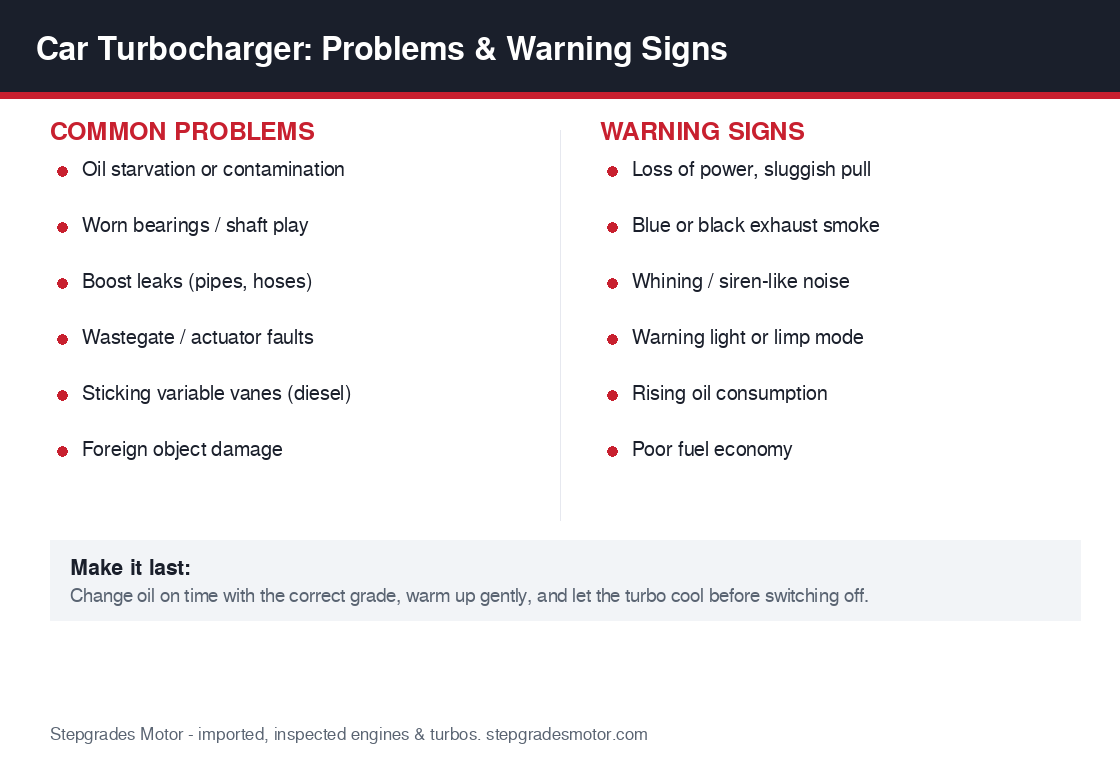
Common car turbocharger problems
Turbos work in a brutal environment — extreme heat, extreme speed and total dependence on clean oil — so when something goes wrong, it’s usually one of these:
Oil starvation or contamination
The number-one turbo killer. If the oil supply is interrupted, dirty, or the wrong grade, the bearings spinning at over 100,000 rpm quickly wear or seize. Blocked oil feeds, infrequent oil changes and poor-quality oil are all common culprits.
Worn bearings and shaft play
Over time, or through oil problems, the shaft bearings wear, allowing the shaft to wobble. This “shaft play” lets the wheels contact their housings, causing rapid failure.
Boost leaks
Cracked or loose pipes, hoses and intercooler connections let compressed air escape before it reaches the engine, causing a loss of power and poor performance.
Wastegate and actuator faults
A sticking wastegate or faulty actuator can cause overboost or underboost, upsetting performance and sometimes triggering limp mode.
Variable-vane sticking
On VGT diesel turbos, soot and carbon can cause the variable vanes to stick, especially on cars used only for short trips, leading to erratic boost.
Foreign object damage and overspeeding
Debris entering the turbo, or the turbo being forced to spin beyond its limits (often through tuning or a fault), can destroy the delicate wheels.
Symptoms of a failing turbocharger
A failing car turbocharger usually gives warning signs before it fails completely. Watch for:
- Loss of power and sluggish acceleration, as boost drops.
- Excessive exhaust smoke — blue smoke (oil burning from a leaking turbo) or black smoke (fuelling issues).
- A whining or siren-like noise from the engine, often a sign of a bearing or boost-leak problem.
- The engine warning light or the car dropping into “limp mode” to protect itself.
- Increased oil consumption, as oil escapes past failing seals.
Catching these early can be the difference between a repair and a far more expensive failure — including debris from a disintegrating turbo being drawn into the engine itself.
What causes turbocharger failure?
Most turbo failures come back to a handful of avoidable causes:
- Oil problems — infrequent changes, wrong grade, low level or a blocked oil feed, starving or contaminating the bearings.
- Not letting the turbo cool down — switching off immediately after hard driving, so hot oil “cokes” in the bearings.
- Short-trip driving — especially on diesels, causing carbon and soot build-up and sticking vanes.
- Foreign objects entering the intake or exhaust.
- Over-boosting from faulty controls or aggressive tuning.
The encouraging news is that nearly all of these are within your control. Look after the oil and treat the turbo kindly, and it can last the life of the engine.
Can you drive with a failing turbocharger?
It’s risky and best avoided. A failing turbo can cause a sudden loss of power that may be dangerous, and — more importantly — a disintegrating turbo can send metal debris or oil into the engine, turning a turbo repair into a complete engine failure. If you notice the warning signs, especially unusual noises, blue smoke or a sudden power loss, it’s safest to stop driving and have it checked promptly rather than risk catastrophic, expensive damage.
How to make your turbocharger last
A few simple habits dramatically extend the life of a car turbocharger:
- Change the oil on time, with the correct grade. This is the single most important thing you can do — clean oil is the turbo’s lifeblood.
- Let the engine warm up gently before driving hard, so the oil is flowing and up to temperature.
- Let it cool down after hard or motorway driving — idle for a short while or drive the last minute or two gently before switching off.
- Give diesels a regular longer run to keep the variable vanes and particulate filter clear.
- Don’t ignore warning signs — early attention prevents major damage.
Treat the turbo well and it will reward you with years of reliable, efficient performance.
Turbocharger repair vs replacement
When a turbo does fail, you have a few options. Minor issues — a boost leak, a faulty actuator or a split pipe — can often be repaired relatively affordably. A worn-out turbo can sometimes be reconditioned or rebuilt by a specialist, replacing the bearings, seals and wheels. If it’s beyond repair, a replacement turbo (new or quality reconditioned) is fitted.
Crucially, whenever a turbo fails due to oil problems, the cause must be fixed and the oil system thoroughly cleaned, or the replacement will fail too. And if a failing turbo has already contaminated or damaged the engine, a complete replacement engine may be the more sensible route. Diagnosing exactly what’s happened is key to choosing the right, cost-effective fix.
How much does turbocharger replacement cost in Europe?
There’s no single figure, because cost depends heavily on the car, the type of turbo and the route you take. A minor repair — a boost leak, a split pipe or a faulty actuator — is usually the cheapest fix. A quality reconditioned turbo, correctly fitted, generally costs less than a brand-new OEM unit, and is a popular middle option. A new OEM turbocharger is the most expensive part, and to any of these you must add the labour to fit it, which can be significant since the turbo is often awkwardly placed.
Prices also vary across Europe with local labour rates and parts availability. When comparing quotes, remember two things: first, always factor in fixing the underlying cause (such as flushing the oil system), or you’ll be paying twice; and second, if the failed turbo has damaged the engine, the economics can shift towards a complete replacement engine instead. A reputable supplier will help you weigh these options honestly rather than simply selling you the most expensive part.
Turbocharged vs naturally aspirated: which is better?
With turbos now so common, many buyers wonder whether a turbocharged engine is the right choice over a traditional naturally aspirated one. Each has its place. A turbocharged engine offers more power and better economy from a smaller unit, strong low-down torque, and lower emissions — but adds complexity and a component that needs care. A naturally aspirated engine is simpler, often cheaper to maintain, and delivers power in a smooth, linear way, but makes less power for its size and is increasingly rare on new cars.
For most European drivers today, the turbocharged engine’s blend of performance and efficiency makes it the sensible, and often the only, choice on modern models. A naturally aspirated engine can still be appealing on an older car or for a driver who prizes simplicity and low running costs. Whichever you run, the fundamentals of engine care apply — and if you’re weighing engine options more broadly, our guides on the types of car engine et petrol versus diesel go further.
Buying a replacement turbo or turbocharged engine
If you need a replacement, buying carefully matters. For a turbo unit, match the exact part for your engine, buy from a reputable supplier who tests units, and always address the cause of the original failure first. For a complete turbocharged engine, check that the turbo is included and has been inspected, and confirm the engine code matches your vehicle.
Because the turbo is such a common failure point, checking it is a key part of inspecting any used engine — something we cover in our guide on how to check a second hand engine. You’ll find turbochargers and related parts among our car parts and accessories, and complete turbocharged units among our inspected moteurs de voitures d'occasion. If you’re unsure what your car needs, send us your registration and we’ll help.
Foire aux questions
How does a car turbocharger work?
What are the symptoms of a failing turbocharger?
What causes a turbocharger to fail?
Can I drive with a failing turbo?
Can a turbocharger be repaired, or must it be replaced?
En résumé
The car turbocharger is a brilliant piece of engineering — turning wasted exhaust energy into extra power and efficiency, which is why it now features on most new cars in Europe. It works by using exhaust gas to spin a turbine that drives a compressor, forcing more air into the engine. But it’s a hard-working component that lives on clean oil, and most turbo failures come down to avoidable causes like poor oil maintenance, not cooling down, or short-trip driving. Look after it, watch for the warning signs, and a turbo can last the life of the engine.
If your turbo or turbocharged engine does fail, address the cause and fit a quality replacement. Browse our inspected moteurs de voitures d'occasion et car parts, read our guides on car engine parts et petrol versus diesel engines, ou contactez notre équipe with your registration and we’ll help you find exactly what your car needs.
 English
 Deutsch
 Français
 Italiano
 Español
 Nederlands
 Polski